
Bangladesh's Minorities Face a Test of Rights, Security and Equal Citizenship
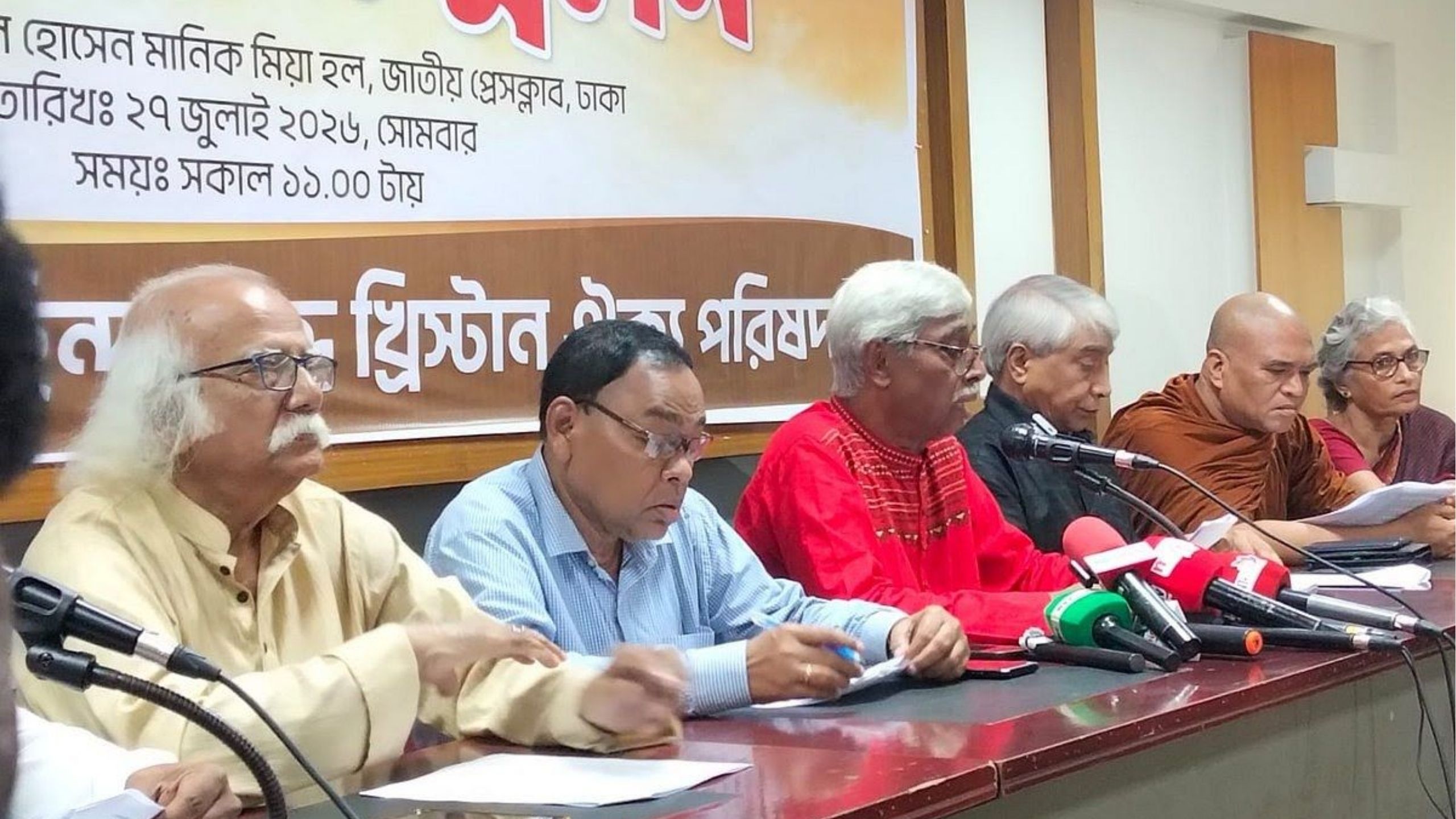
At a press conference the leaders of the Bangladesh Hindu Buddhist Christian Unity Council gave a report in which they alleged that there had been 257 cases of communal violence affecting the minority communities during the first six months of 2026.
Bangladesh's Minorities Face a Test of Rights, Security and Equal Citizenship
Sangram Datta:
The way in which religious minorities are treated is still one of the best indicators of the democratic condition in Bangladesh. Although the country was founded upon the principles of pluralism, equality and linguistic nationalism, it has had to face repeated outbreaks of communal violence, accusations of land being taken away and ongoing worries that minority groups end up bearing a greater share of the burden during times of political instability.
The situation is not simple nor one-sided; accounts provided by international organisations, the UK Home Office, domestic rights groups, civil society organisations and independent media all refer to a nation in which constitutional protections exist alongside a series of incidents that are still causing a loss of confidence among a great many minority citizens.
The Constitution of Bangladesh ensures equality before the law, bans discrimination on religious grounds and safeguards the freedom of worship, while at the same time acknowledging Islam as the state religion. The various governments have on numerous occasions stated their commitment to religious harmony, and security is regularly arranged during major religious festivals such as Durga Puja, Christmas and Buddha Purnima.
But constitutional guarantees alone cannot decide if people truly feel safe.
The Country Policy and Information Note issued by the UK Home Office in June 2025 states that Bangladesh usually offers legal protection to religious minorities and that these groups are generally able to carry out their religion freely. Yet the document also records instances of communal violence, observes that the number of attacks rose during the political disturbances of 2024, and points out concerns regarding laws which criminalise alleged offences against religious sentiment.
The report also notes that although a large number of the incidents seemed to be the result of political conflict rather than simply religious hatred, minority groups still experienced deaths, injuries, the destruction of their homes and attacks on places of worship. Yet for the victims, the difference between political and communal motives brings them very little comfort when it appears that their faith or identity makes them more vulnerable.
Civil society organisations give a more alarming account.
The Bangladesh Hindu Buddhist Christian Unity Council (BHBCUC) stated that from January to June 2026 it recorded 257 cases having an impact on minority groups, among these 44 deaths in 40 separate cases. The organisation also mentioned incidents involving attacks on places of worship, allegations of land grabbing, assaults on women, extortion, arrests on the grounds of having injured religious feelings and attacks on homes and businesses.
The figures are based on the council's own records and not on independently verified national statistics. Yet they are worth careful consideration since they illustrate the concerns which have been repeatedly raised over many years by both domestic and international observers.
In July 2026, Prothom Alo's English edition gave an account of the council's findings and called for a policy of zero tolerance with regard to communal violence as well as for institutional reforms, such as a Minority Protection Act, the establishment of a National Minority Commission and improved legal safeguards.
International human rights organisations have expressed similar concerns.
Human Rights Watch has on several occasions cautioned that attacks on religious minorities continue to pose a major problem and has called on the authorities to improve the measures providing protection. The international community also turned its attention to the case of garment worker Dipu Chandra Das who was killed in December 2025 after the BBC had reported on the dangers presented by violence carried out by mobs based on accusations of blasphemy or religious offence.
These events are part of a wider pattern.
Bangladesh has suffered repeated outbreaks of violence after it was alleged that posts on social media or perceived insults to Islam had offended religious feelings. During the violence associated with Durga Puja in 2021, attacks spread to various districts from allegations that started in Comilla, resulting in temples being damaged, houses being destroyed and people being killed.
These situations reveal a continual weakness within the institution—the rumours spread quickly, the local tensions rise rapidly and minority groups are often the most vulnerable.
Land rights are still another source of concern.
For a long time minority groups, researchers and various international human rights organisations have recorded the claim that Hindu families have been more heavily affected than others by land grabbing and disputes over property. Although the previous Vested Property system was heavily criticised for enabling decades of dispossession, later reforms were aimed at dealing with some of its effects.
Even with the reforms in place, there are still accusations that influential people take advantage of the complexity of the law, the delays in administration, and the unequal access to justice in order to gain property that is in dispute. Since individual cases are always different, they should each be evaluated in light of their specific circumstances, and the allegations must be handled with care unless they are backed by court rulings, official investigations or some other verifiable evidence.
The general problem goes beyond separate disagreements. For a great many minority families, land stands for much more than just its economic worth; it is closely connected with identity, security, the question of inheritance and a sense of historical belonging. If disputes continue to remain unresolved over a period of years, confidence in the possibility of equal access to justice will certainly be damaged.
Enjoying this article?
Subscribe to get more stories like this delivered to your inbox.
The authorities in Bangladesh deny that there is widespread communal violence or that such violence is deliberately aimed at minority groups. When looking into the incidents of violence that occurred after the political upheaval in August 2024, official inquiries found that a large number of the cases reported were politically motivated and not religious in origin. Moreover, government officials have cited the number of arrests, criminal investigations and the increase in security forces as proof of the state's dedication to safeguarding vulnerable communities.
The efforts should be acknowledged. Yet the effectiveness of protection is not so much judged by constitutional assurances or by what officials say as it is by the results—whether people feel safe in their homes, whether places of worship stay secure, whether property rights are protected and whether those who are responsible for communal violence are investigated and prosecuted in an impartial manner, no matter what political influence there may be.
In the last two decades Bangladesh has achieved substantial advances in both the economic and social fields and still aims at attaining democratic stability as well as greater international influence. In order to keep these achievements it is necessary to make sure that every citizen—whether Muslim, Hindu, Buddhist, Christian, Ahmadi or non-believing—enjoys equal protection under the law.
Pluralism cannot depend entirely on the language in the constitution; it is necessary that institutions be in place which can protect vulnerable communities, settle disputes fairly, apply the rule of law without discrimination, and make sure that no citizen lives in fear of violence on account of their faith, identity or perceived differences.
Bangladesh's democracy will eventually be judged not just on the basis of elections, economic growth or public order, but also on whether people in everyday life actually experience equal citizenship as well as having it guaranteed by law.