
Sweden: The quiet power that chose trust over fear
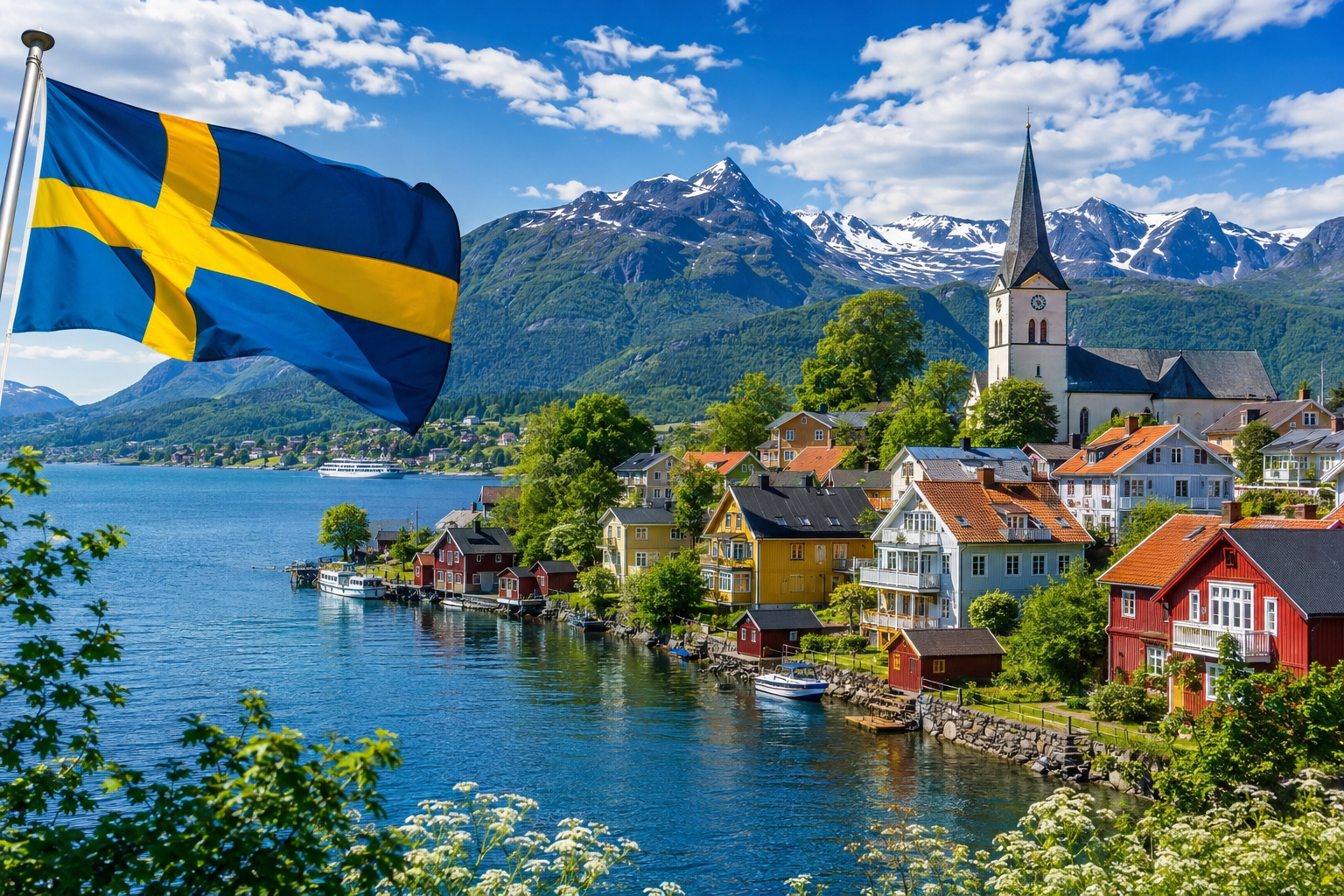
A breathtaking panorama of Sweden's pristine natural beauty, where tranquil waters, colourful coastal villages, majestic mountains and the iconic blue-and-yellow national flag reflect the country's harmony between nature, heritage and modern life.
There are countries that command attention through the size of their economies, the reach of their militaries or the weight of their geopolitical influence.
Then there are countries like Sweden, whose reputation has been built more quietly—through stable institutions, social trust, innovation and an enduring belief that prosperity should be shared.
Tucked into the northern reaches of Europe, with a population of just over 10.6 million spread across 450,295 square kilometres, Sweden has become one of the world's most admired societies. It is also widely regarded as one of the most beautiful countries in the world, where deep forests, mirror-like lakes, dramatic mountains, Arctic wilderness and thousands of islands combine to create landscapes that are both spectacular and carefully protected.
Its natural beauty is inseparable from its climate. Sweden stretches more than 1,500 kilometres from south to north, giving the country a remarkable diversity of weather. Southern cities such as Malmö, Lund and Gothenburg enjoy comparatively mild winters and pleasant summers, while Stockholm experiences four distinct seasons with warm summer days and crisp, snowy winters. Farther north, around Umeå, Kiruna and the vast expanse of Swedish Lapland, winters are long and severe, with temperatures frequently falling well below freezing, while summer brings the extraordinary phenomenon of the Midnight Sun.
For many international visitors and professionals, the southern and central regions—including Stockholm, Uppsala, Västerås, Linköping and Gothenburg—offer the most comfortable year-round climate, with summer temperatures typically ranging between 20°C and 25°C and winter temperatures generally remaining manageable compared with the Arctic north.
Sweden's story is not one of effortless success. It is the product of centuries of political evolution, economic reform and a determination to invest in people rather than short-term popularity. From its Viking roots, when Swedish traders travelled across the Baltic and into Eastern Europe, to its emergence as a major European power in the seventeenth century, the country has experienced both ambition and upheaval.
Yet one of the defining features of modern Sweden has been its long period of peace. Since 1814, it has avoided war on its own territory, allowing successive generations to channel national resources into education, public infrastructure, scientific research and democratic institutions instead of reconstruction.
That continuity has helped create one of the world's most stable constitutional monarchies and parliamentary democracies. Sweden's institutions enjoy a high degree of public confidence, corruption remains among the lowest globally, and government transparency is embedded in political culture.
These qualities rarely generate dramatic headlines, but they have proved far more valuable than political spectacle.
The country's economic transformation has been equally remarkable. Despite its relatively small domestic market, Sweden has become a global industrial and technological powerhouse. Internationally recognised companies such as IKEA, Volvo, Ericsson, Scania, H&M, SKF, Electrolux, Spotify and Klarna illustrate a national ability to combine engineering excellence with entrepreneurial ambition.
Advanced manufacturing, telecommunications, pharmaceuticals, green technology, renewable energy, forestry, mining and digital innovation continue to drive growth, making Sweden one of Europe's most competitive high-income economies.
Yet economic success alone does not explain why Sweden consistently appears near the top of international rankings for happiness, education, innovation, gender equality and quality of life.
The country's distinctive achievement lies in its determination to balance economic competitiveness with social responsibility. Universal healthcare, publicly funded education, generous parental leave, subsidised childcare, unemployment protection, pensions and support for older people are not viewed simply as government spending. They are widely regarded as investments in human potential and social stability.
These programmes are financed through comparatively high taxation, but they rest upon an equally important foundation: trust. Citizens generally expect public institutions to use resources responsibly, while governments recognise that maintaining confidence requires transparency, accountability and efficient administration. The relationship is reciprocal. Taxes fund services, services strengthen public confidence and confidence reinforces social cohesion.
Sweden's success has also been shaped by its educational philosophy. Schools and universities encourage independent thinking, creativity and problem-solving rather than rote memorisation. Research and development receive sustained public and private investment, helping to explain why Swedish companies continue to compete successfully in advanced industries despite the country's modest size.
Language has never become a barrier to international engagement. Swedish is the official language, while recognised minority languages include Sami, Finnish, Meänkieli, Romani Chib, and Yiddish. At the same time, English is spoken fluently by much of the population, making Sweden one of the easiest countries in Europe for international students, investors and skilled professionals to navigate.
For young people seeking employment, Sweden offers opportunities across software development, artificial intelligence, engineering, healthcare, biotechnology, renewable energy, scientific research, education and skilled trades. Employers value qualifications, experience and adaptability, but many positions also require competence in Swedish, reflecting the importance of integrating into the workplace and wider society.
That expectation has become increasingly visible in Sweden's immigration policy. Having accepted significant numbers of migrants and refugees over several decades, the country has gradually tightened aspects of its immigration system.
Greater emphasis is now placed on learning the Swedish language, understanding the country's democratic values, participating in integration programmes and, in some cases, demonstrating language and civic knowledge for long-term residence or citizenship. These measures reflect an effort to strengthen social cohesion while responding to domestic political debate over integration and migration.
Sweden's international influence extends well beyond economics. Following decades of military non-alignment, it joined NATO in 2024, responding to a rapidly changing European security landscape after Russia's invasion of Ukraine. Although its armed forces are relatively modest in size, Sweden possesses highly sophisticated defence capabilities, including the domestically produced Gripen fighter aircraft, advanced submarines and one of Europe's most innovative defence industries.
Its cultural influence is equally significant. Sweden introduced one of the world's earliest freedom of the press laws in 1766, a milestone that reflected an enduring commitment to openness and democratic accountability. The Nobel Prize, awarded annually in Stockholm in every category except the Peace Prize, remains one of humanity's highest recognitions of scientific discovery, literature and public service. Swedish society has also become synonymous with environmental stewardship, renewable energy, sustainable urban planning and a lifestyle that prizes balance as much as achievement.
Enjoying this article?
Subscribe to get more stories like this delivered to your inbox.
To visit Sweden is to encounter a country where nature is not treated as a luxury but as a shared inheritance. The principle of Allemansrätten, or the Right of Public Access, allows people to walk through forests, hike across mountains and enjoy much of the countryside responsibly, regardless of land ownership. It reflects a broader national belief that the natural world belongs to everyone and should be preserved for future generations. In summer, the Midnight Sun bathes the Arctic in daylight for weeks, while winter brings snow-covered forests, frozen lakes and the dazzling spectacle of the Northern Lights. These extraordinary surroundings are inseparable from Sweden's identity and help explain why it is so often described as one of the world's most beautiful countries.
Sweden is not without its difficulties. Like many advanced democracies, it faces challenges linked to housing shortages, rising living costs, demographic change, organised crime, integration and the pressures of an increasingly uncertain global economy. Public debate over these issues is vigorous, and political consensus is not always easy to achieve. Yet Sweden's institutions have repeatedly shown an ability to adapt without abandoning the principles that underpin the country's success.
Perhaps that is Sweden's greatest lesson. Civilisation is not measured by the height of skyscrapers, the size of military budgets or the volume of national rhetoric.
It is measured by the strength of public institutions, the integrity of governance, the opportunities available to ordinary citizens and the confidence people have that tomorrow can be better than today. Sweden has spent generations building that confidence through education, innovation, democratic accountability and social responsibility.
In an era increasingly defined by political division and economic uncertainty, Sweden offers a reminder that national success is rarely accidental. It is built patiently, protected carefully and sustained through choices that place long-term public interest above short-term political gain.
For all its breathtaking landscapes, comfortable living standards, vibrant economy and remarkable prosperity, Sweden's greatest achievement may simply be this: it has shown that a modern nation can pursue economic excellence without abandoning compassion, and that trust, once earned and preserved, can become a country's most valuable resource.
Contributing writer at The Independent News