
Gandhi’s Struggle for Peace in Noakhali

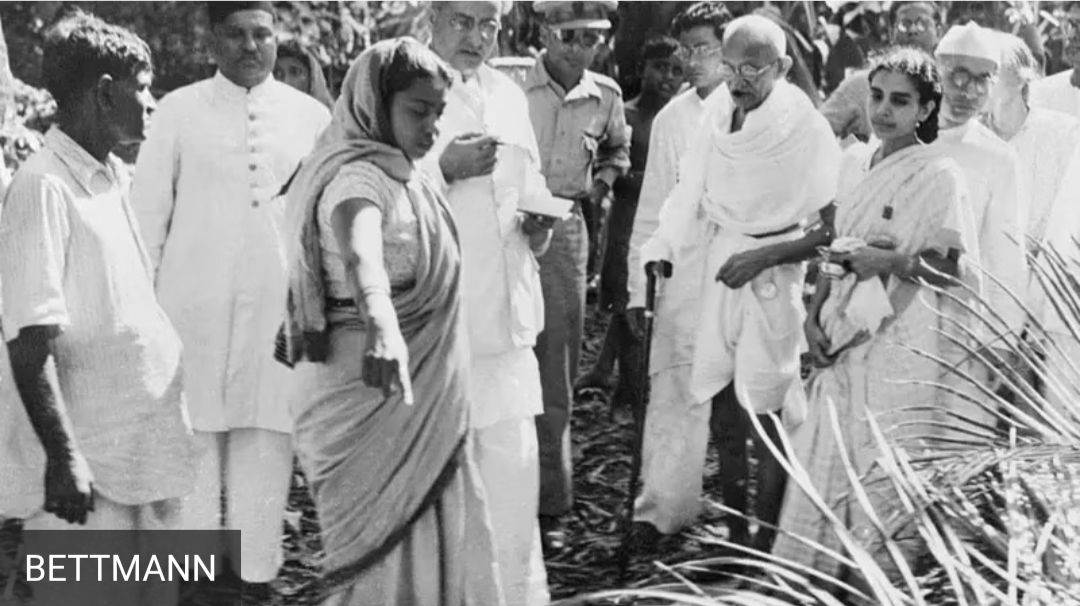
Mahatma Gandhi walking barefoot through Noakhali during his 1946–47 peace mission, seeking to heal communities torn apart by communal violence.
On October 2, 2019, BBC News Bangla published a report titled “Gandhi in Noakhali: The Bloody Chapter of a Communal Massacre,” revisiting one of the darkest episodes in the history of Bengal. At the centre of that story was Mahatma Gandhi, walking barefoot through the villages of Noakhali after communal violence had torn apart families, destroyed homes and driven thousands of people from their communities.
Gandhi arrived in Noakhali at a time when words such as peace and reconciliation had almost lost their meaning. People had been killed, houses had been burned, women had suffered sexual violence, and thousands of Hindus had been forced to leave their homes or accept conversions under pressure. Yet Gandhi chose to walk through those very villages, meeting people face to face and asking them to find a way back from hatred.
That decision tells us something important about the man himself. Gandhi was not coming to Noakhali with a political settlement in his pocket. He knew there was no easy answer. He came because he believed that if people were willing to listen to one another, however painful that process might be, some trust could still be restored.
The timing could hardly have been worse.
A year before the Partition of India, Bengal was already caught in a cycle of communal tension. The Great Calcutta Killings of August 16, 1946, had left 4,000 people dead and more than 100,000 homeless. The violence deepened the mistrust between Hindus and Muslims and spread into other parts of eastern India.
In Noakhali, another wave of violence began on October 10, during Lakshmi Puja (Laxmi Festival).
A rumour was circulated that a monk named Sadhu Triyambakananda, who was said to be staying at the home of Rajendralal Chowdhury, a local zamindar, had declared that he would please the goddess not with the blood of goats but with the blood of Muslims.
The accusation was false, but rumours rarely wait for facts before doing their damage.
The story reached Golam Sarwar Hossaini, the Sufi leader of Shyampur Daira Sharif. He sent a message to Chowdhury suggesting that they meet and discuss the matter. When no response came, Hossaini convened a mass gathering at Shahpur Bazaar, denounced the Hindu landlord and called on Muslims to rise.
The violence that followed spread quickly.
Markets were looted. Houses were burned. People were killed. The Chowdhury estate was attacked, and Rajendralal was killed after a desperate fight. Triyambakananda survived and escaped.
In Raipur, another landlord, Chittaranjan Ray Chowdhury, became the target of similar violence. Appeals to the Congress Party, and even to Gandhi himself, did not result in intervention. Hossaini’s followers eventually surrounded the zamindar’s house. Ray Chowdhury reportedly killed his own family before taking his own life.
The breakdown of law and order extended across Noakhali and adjoining areas, including Lakshmipur, Begumganj, Chhagalnaiya and parts of Comilla. Historians estimate that more than 5,000 Hindus were killed.
What made Noakhali particularly horrifying was not only the scale of the killings. The attacks were overwhelmingly directed at the Hindu minority. Many Hindu women were subjected to sexual violence, while thousands of people were forcibly converted to Islam and pressured into signing declarations claiming that the conversions had been voluntary.
Yet the story cannot be understood only through the lens of religion.
Golam Sarwar Hossaini was a religious leader, but he was also a political figure. As head of the Noakhali Peasants’ Association, or Krishak Samiti, he supported agrarian reforms, opposed exploitative moneylenders and campaigned for the abolition of rent. His influence among poor Muslim farmers put him at odds with Noakhali’s Hindu landed elite.
The Congress Party had briefly sought his support before distancing itself from him.
Political rivalry, economic grievances and communal tensions gradually became entangled. What might have begun as a conflict over land, class and power was increasingly expressed through religious identity. Once that happened, the consequences were devastating.
Thousands of Hindu refugees fled to temporary camps in Comilla, Chandpur and Agartala.
Gandhi decided to go to Noakhali.
He knew he might accomplish very little. He told his secretary, Nirmal Kumar Bose, that he might have to remain there “for many years” if he was to help heal the wounds of the region.
On November 6, 1946, he began his journey. He spent two nights at the home of Jogendra Majumdar in Choumuhani and then continued through the villages affected by the violence.
Over the course of his mission, Gandhi walked 116 miles barefoot and visited 47 villages.
He prayed with survivors. He spoke to Muslim villagers. He listened. He tried to persuade people who had lost relatives, homes and trust in their neighbours that they could still live together.
There was something almost painfully simple about the method. Gandhi walked from one village to another because there was little else he believed he could do.
He also wanted to meet Golam Sarwar Hossaini.
Hossaini initially refused. He did not trust Gandhi and rejected his intervention. Eventually, at Gandhi’s insistence, the two met in Chatkhil.
Hossaini told Gandhi that Noakhali could not be considered in isolation. He argued that peace would return only when violence in Calcutta and Bihar also ended.
The meeting was made even more bitter by an incident involving Gandhi’s goat.
The goat, whose milk Gandhi relied on, had been seized by Hossaini’s men. During the meeting, the cooked meat of that same goat was reportedly placed before Gandhi, a vegetarian. Whether intended as an insult or a test of his patience, the gesture captured the hostility surrounding the encounter.
Gandhi did not respond with anger.
He continued his work.
But there were moments when even his confidence seemed to falter. His presence could bring people together for a prayer meeting or a conversation, but it could not erase fear or bring back those who had been killed. Nor could it guarantee that violence would not return after he had moved on.
That was the painful reality of Noakhali.
Gandhi is remembered around the world as the leader who developed Satyagraha, the philosophy of nonviolent resistance that became central to India's struggle for independence. His example influenced civil rights movements far beyond South Asia, and the title “Mahatma”, meaning “great soul”, became inseparable from his name.
But Noakhali reveals another side of his legacy.
It shows a Gandhi confronting a situation in which moral authority had limits. He could appeal to conscience, but he could not control the actions of others. He could walk among frightened people, but he could not promise them that they would be safe.
In early 1947, violence erupted again in Bihar, where Muslims were massacred in retaliation. The Muslim League urged Gandhi to go there.
On March 2, 1947, he left Noakhali.
Enjoying this article?
Subscribe to get more stories like this delivered to your inbox.
His mission was unfinished.
A month later, he was told that attacks were still continuing. His response was devastatingly direct:
“The situation in Noakhali is so unbearable that the Hindus must either leave — or perish.”
Those words are difficult to read even today.
Gandhi had spent nearly three months in Noakhali trying to persuade people to live without fear of one another. He had walked from village to village, spoken to survivors, and pleaded with communities to reject revenge. Yet by the time he left, he knew that the wounds were far from healed.
The story of Gandhi in Noakhali should therefore not be remembered simply as the story of a great man bringing peace to a troubled region. That would make the history too neat.
It was messier than that.
Noakhali was a place where neighbours became enemies, where political and economic grievances acquired a communal character, and where ordinary people paid the highest price. Gandhi entered that world with an extraordinary belief in the possibility of reconciliation. He left with a painful understanding of how difficult that reconciliation could be.
The theft of his goat, sometimes repeated as a curious or even humorous anecdote, looks very different when placed against that background. It was a small incident in a much larger tragedy, but it also reflected the hostility Gandhi was confronting.
His greatest contribution in Noakhali may not have been that he succeeded in ending the violence. He did not.
It was that he refused to abandon the people caught in it.
He chose to walk into villages where fear had replaced trust. He chose to listen when there was little reason for either side to listen, and he stayed long enough to show that peace could not be demanded from a distance; it had to be sought among the people who had been divided.
India became independent in 1947, but independence came with Partition, displacement, and immense loss of life. The freedom that Gandhi and others had fought for could not shield millions from the consequences of communal hatred.
Noakhali remains part of that difficult history.
For an international audience, its lesson is still painfully familiar: political freedom does not by itself create social peace. Once fear becomes stronger than trust, and identity becomes more important than humanity, rebuilding a broken community can take far longer than destroying it.
Gandhi went to Noakhali hoping that his presence might help people find their way back to one another.
He left knowing that some wounds cannot be healed by one man, however revered he may be.
Contributing writer at The Independent News