
Philippine National Police and Norway join forces against online child sexual abuse—Arrests already made on both sides

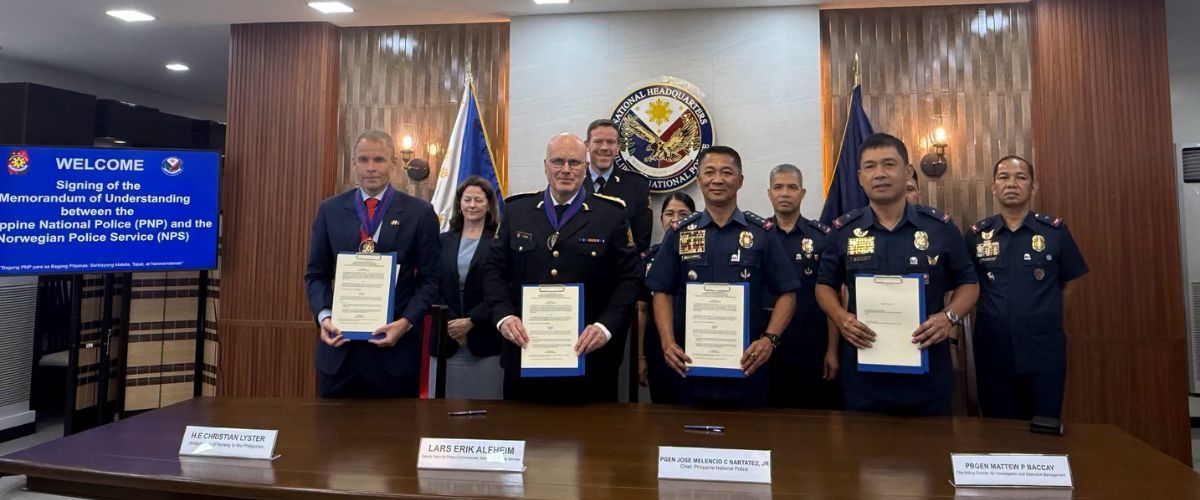
Signing of MoU between PNP and NPS
PHILIPPINES / NORWAY: The Philippine National Police (PNP) has formalised a new intelligence-sharing agreement with Norway’s police service to intensify the fight against online sexual abuse and exploitation of children (OSAEC), with PNP chief Gen. Jose Melencio Nartatez Jr. directing nationwide units to immediately leverage the expanded partnership against transnational offenders.
According to the Philippine News Agency (PNA), the move follows the recent signing of a memorandum of understanding between Nartatez and Norwegian Deputy Police Commissioner Lars Erik Alfheim, which builds on an existing working relationship between the two countries that dates back to 2020 through the Nordic Liaison Office.
What the agreement covers
The MOU expands cooperation between the two police organisations by allowing broader information sharing to identify offenders, rescue victims, and investigate cross-border OSAEC cases. It formalises and deepens what had previously been a more informal intelligence relationship, giving both sides a clearer framework for acting on leads that cross national boundaries.
Following the signing, Nartatez directed the Women and Children Protection Center (WCPC), the Anti-Cybercrime Group (ACG), and all Police Regional Offices to strengthen monitoring and act immediately on intelligence obtained through the partnership. He also ordered capability-building and specialised training for cyber investigators and digital forensic personnel, drawing on best practices from Norwegian law enforcement.
Already delivering results
The Norwegian Embassy in Manila confirmed that intelligence provided by Norwegian authorities has already supported several law enforcement operations in the Philippines, leading to the rescue of children from abusive situations and the identification of offenders. The same intelligence also resulted in the arrest of perpetrators in Norway who had commissioned the abuse remotely.
It is the transnational nature of the crime and the cross-border response that makes the partnership particularly significant. Offenders based in Norway were commissioning the abuse of children in the Philippines, with digital infrastructure spanning both countries. The existing cooperation has already demonstrated that dismantling these networks requires law enforcement on both ends to be working from the same intelligence.
“We are no longer just reacting to crimes”
Nartatez framed the agreement as a shift from reactive enforcement to proactive, intelligence-driven operations. “Crime knows no borders, and our response must be equally boundless. This agreement formalises a vital intelligence pipeline that allows us to strike at the digital infrastructure of these predators, ensuring that our children are protected before they are targeted,” he said, as quoted by the PNA.
He added that the ACG and WCPC have been directed to integrate international intelligence into daily tactical operations. “We are no longer just reacting to crimes. We are leveraging global data to identify and dismantle these networks at their source,” Nartatez stated.
Enjoying this article?
Subscribe to get more stories like this delivered to your inbox.
A priority from the top
The intensified anti-OSAEC campaign is aligned with a directive from President Ferdinand Marcos Jr., channelled through Interior Secretary Jonvic Remulla, to escalate the country’s efforts against online child sexual exploitation, PNA reports.
Norwegian authorities said the new agreement will allow both countries to exchange information more quickly, enabling intervention before more children become victims, rather than after abuse has already occurred.
For a crime that is both deeply intimate in its harm and thoroughly transnational in its operation, the speed of that intelligence exchange may be the difference between a child being rescued and a child being harmed.
Read also: Philippine Navy launches third landing dock in Indonesia, fourth to follow before year’s end
Writer