
Trump dismisses last Democratic election commissioners, leaving federal agency without quorum

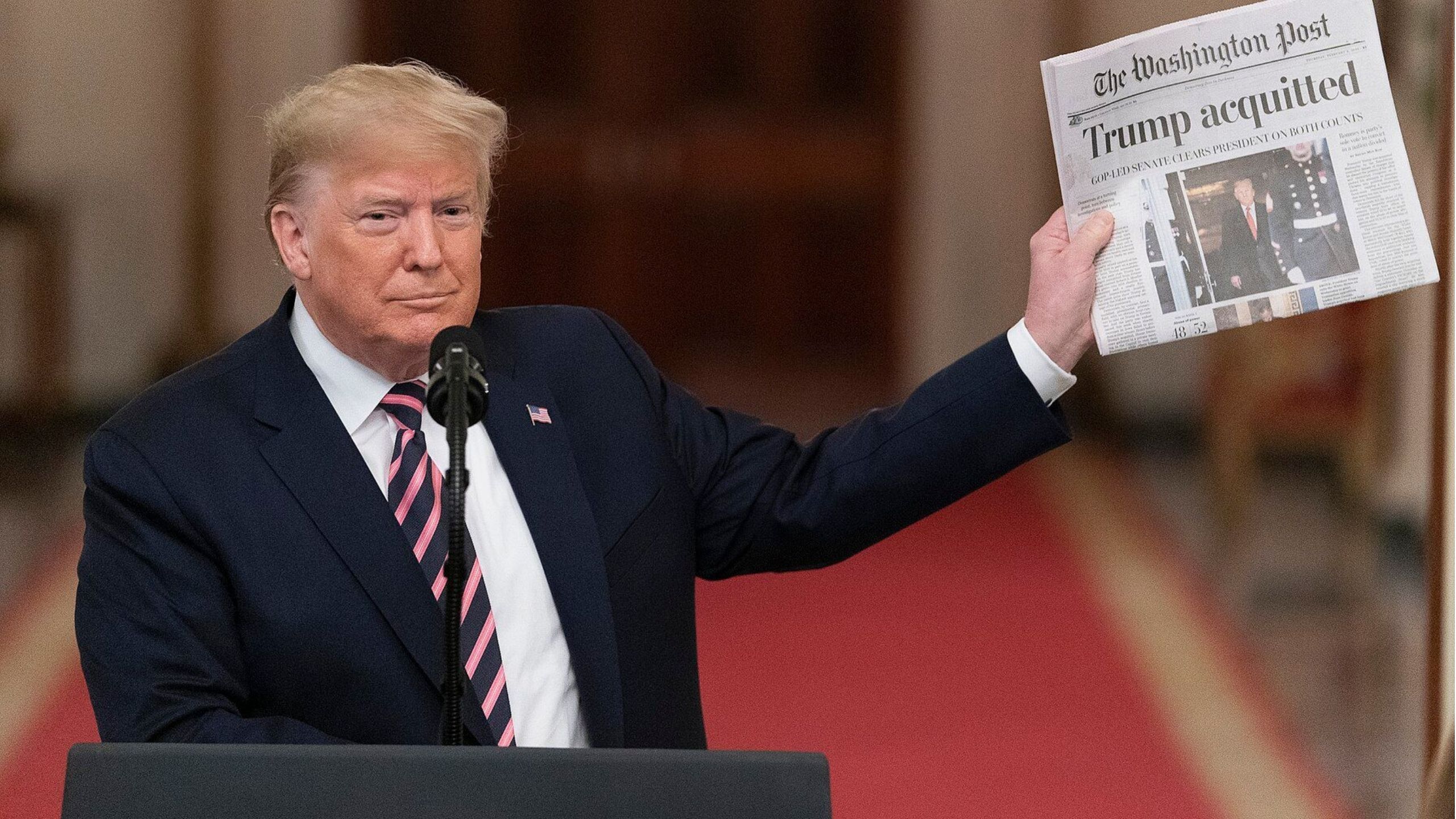
Photo: President Donald Trump displaying the headline "Trump acquitted" in 2020
USA: President Donald Trump has fired the last two Democratic commissioners from the Election Assistance Commission, the federal agency responsible for certifying voting equipment and overseeing hundreds of millions of dollars in election support funding, just months before November’s crucial midterm elections.
The two commissioners nominated by Democrats received dismissal emails from the Trump administration on Thursday, according to US media reports. The move leaves the four-person bipartisan commission effectively hollowed out: one Republican-chosen commissioner had already resigned in April, and the re`maining Republican-chosen commissioner resigned on Thursday as well.
The White House’s justification
The Trump administration defended the firings by citing a recent Supreme Court ruling that it said granted the president expanded powers to remove members of independent government agencies.
“The President, and head of the Executive Branch, reserves the right to remove individuals that may not be totally aligned with the important task of securing America’s elections and ensuring every legal vote is counted,” a White House official told AFP, adding that the administration was “working across all agencies and local partners to safeguard elections from fraud and abuse” ahead of November.
Democrats call it a power grab
The response from Democratic leaders was swift and unambiguous. Senate Minority Leader Chuck Schumer described the move as a “brazen attempt to seize control of our elections before a single vote is cast,” calling it a power grab that struck at the heart of electoral integrity.
“Firing every remaining member of the bipartisan Election Assistance Commission months before the midterms is a brazen attempt to seize control of our elections before a single vote is cast,” Schumer said on X.
According to AFP, Senator Mark Warner of Virginia called it “an extraordinary step that demands an immediate explanation from the administration.”
The practical consequences
The gutting of the commission has immediate operational implications. To approve any actions, the commission requires agreement from three of its four commissioners, which is now a threshold it can no longer meet. With all positions now vacant or about to become so, filling them could take months, leaving the agency unable to function during one of the most sensitive periods in the US electoral calendar.
The commission certifies voting equipment used across the country and administers significant federal funding that supports state and local election administration. Its paralysis ahead of November raises serious questions about how those functions will be carried out in the interim.
Voting restrictions and the SAVE America Act
The commission firings come amid a broader push by Trump to tighten voting rules before the midterms. His administration has been advancing the so-called SAVE America Act, which would require proof of citizenship to register to vote, mandate photo identification at polling places, and impose new restrictions on mail-in ballots. The legislation has so far stalled in Congress.
Trump had previously clashed with the commission over an executive order directing it to require proof of citizenship on voter registration forms, which was a demand that was largely blocked in court. His frustration over Congress’s refusal to pass the SAVE America Act has been mounting, and on Friday he reportedly said he would refuse to sign a bipartisan housing bill in protest, though the measure is set to become law automatically on Saturday if he neither signs nor vetoes it.
Netizens react: “This is not normal”
The news drew an immediate and visceral response on Reddit, with commenters across the political spectrum expressing alarm, exhaustion, and, in some cases, a grim sense of inevitability.
Several framed the move in constitutional terms. “Trump: ‘We need to nationalise elections’, so he can control them. He's literally the tyrant the constitution was made to stop,” one netizen wrote, referring to the founding document’s original purpose as a check against exactly this kind of executive overreach.
Others pointed directly to the Supreme Court ruling that made the firings legally possible. “This is the consequence of the Supreme Court giving Trump unprecedented powers to fire the heads of any independent federal agency. We’re living in dark, scary times,” one user said, shifting the frame from Trump’s actions alone to the judicial architecture that unfortunately enables them.
A recurring theme in the responses was the sheer accumulation of norm-breaking events and the difficulty of processing each new one. “We’ve reached the point where Trump has committed many acts that would have ended any other president or politician. And yet, these abuses barely survive a news cycle because everyone simply expects it from Trump,” one commenter observed, capturing the dangerous normalisation effect that critics argue is itself part of the problem.
Enjoying this article?
Subscribe to get more stories like this delivered to your inbox.
For others, the frustration has moved well beyond commentary into a demand for consequences. “Anything short of full charges and prison time for him and his administration is a slap in the face to Americans. This isn’t funny, this isn’t cute, this isn’t some stupid ‘oh well he’s out of power now so it’s all ok’ nonsense,” another commenter wrote.
Some responses were shorter but no less pointed. “Because of course he did,” one user wrote, encapsulating the exhaustion and resignation of people following this administration’s moves. Another simply asked: “How are there no checks and balances!?”
Perhaps the most measured but equally alarmed response came from a commenter who kept the focus on the immediate stakes: “This is not normal when the midterms are just a few months away.”
Why this matters beyond the US
The integrity of American electoral institutions has global implications because the United States positions itself internationally as a model of democratic governance. The removal of all remaining commissioners from the body responsible for certifying the country’s voting systems, months before a national election, is the kind of move that would attract sharp international criticism if it occurred in any other country that calls itself a democracy.
For observers in Southeast Asia and beyond, this adds to a growing body of evidence about the fragility of institutional checks and balances when executive power is wielded without restraint. It also shows the speed with which democratic systems can fall apart when those in power choose to test them.
Writer