
Canada’s immigration crackdown is sending a warning far beyond its borders

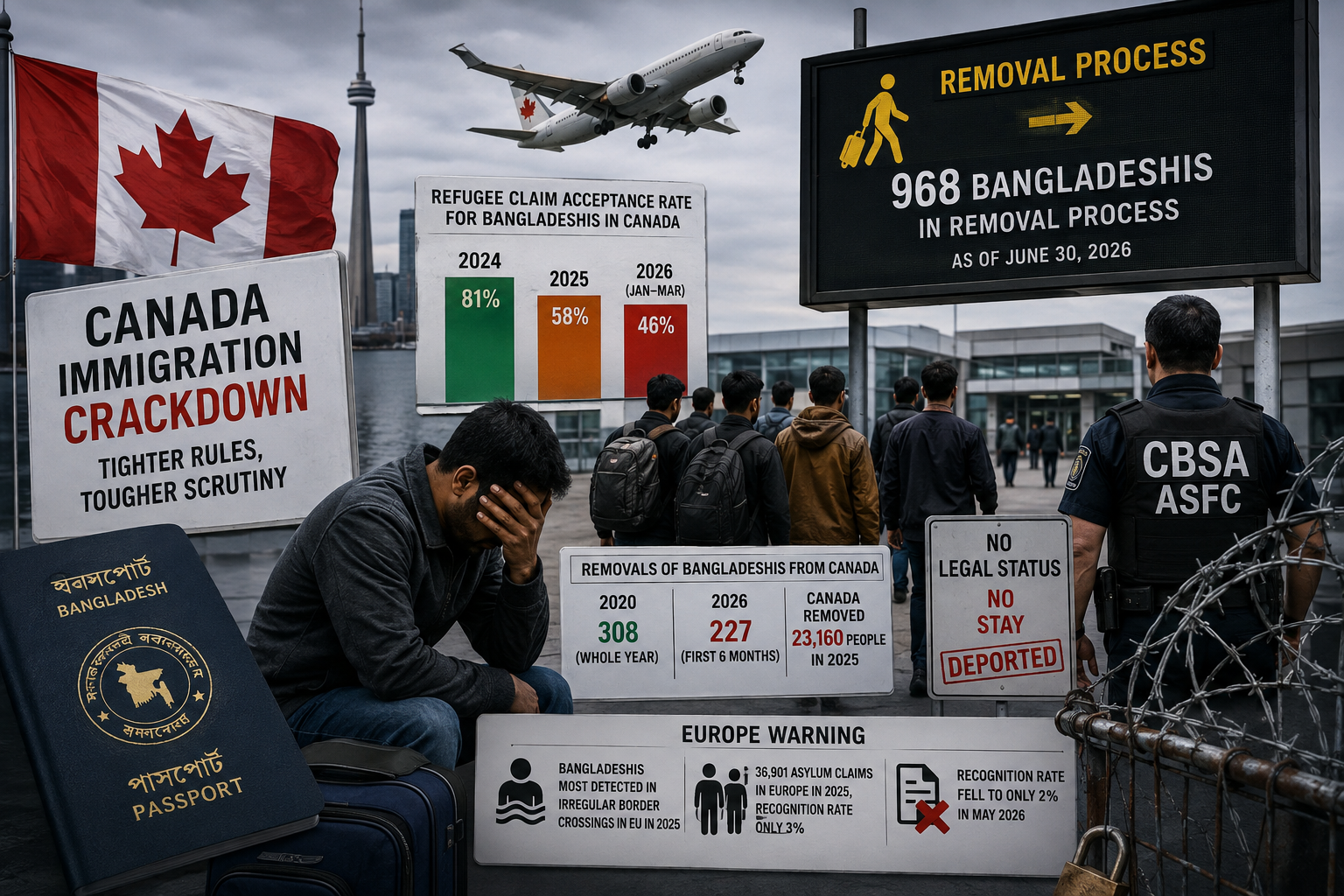
Canada is tightening its immigration and asylum rules, while 968 Bangladeshis were in the removal process as of June 30, 2026. With refugee claim acceptance rates falling in Canada and Europe, the figures raise a broader question about migration, credibility and the future of legal pathways for Bangladeshis abroad.
For years, Canada cultivated an image of itself as one of the world’s most welcoming destinations for immigrants, students and refugees. That reputation did not emerge by accident. It was built into the country’s immigration system and reinforced by a political culture that presented migration as an economic and humanitarian strength.
That era is changing.
Canada is tightening the rules governing visas, asylum claims and the legal status of foreign nationals. The change is not merely a matter of bureaucratic procedure. It is beginning to reshape who can enter Canada, who can remain, who can claim protection and, ultimately, who can build a future there.
The consequences are particularly visible for Bangladeshis.
According to the Canada Border Services Agency (CBSA), 968 Bangladeshis were in the process of being removed from Canada as of June 30, 2026, placing Bangladesh 10th among the top countries represented in that category. Across all nationalities, 40,827 foreign nationals were in the removal process, including 36,622 cases connected to refugee claims.
Those numbers should not be read simply as a measure of immigration enforcement. They are also a signal of how dramatically the environment surrounding migration has changed.
Canada is not alone in moving in this direction. Across Europe, governments are under growing pressure to control irregular migration, accelerate asylum decisions and return people whose claims are rejected. The political language surrounding migration has become harder, and the administrative systems behind it are following the same path.
For Bangladeshis, the warning is becoming increasingly difficult to ignore.
The most striking development is not simply the number of people being removed. It is the declining success rate of Bangladeshi refugee claims.
In 2024, 17,239 Bangladesh-related refugee claims were referred to Canada’s Refugee Protection Division. Of the cases decided that year, 750 were accepted and 175 rejected. In 2025, new referrals fell sharply to 4,070. Yet while 1,203 claims were accepted, 867 were rejected.
During the first three months of 2026, 547 new claims were filed. In the same period, 248 were accepted and 293 rejected. As of March 31, nearly 19,972 Bangladesh-related claims remained pending.
The direction of travel is clear. Based on accepted and rejected decisions alone, roughly 81 percent of decided Bangladeshi claims were accepted in 2024. The proportion fell to about 58 percent in 2025 and to roughly 46 percent in the first three months of 2026.
Statistics, however, cannot tell us everything about the people behind them.
Every asylum application represents an individual story: a family decision, a fear, a financial sacrifice, a journey and, often, a belief that remaining in the country of origin is no longer viable. A falling acceptance rate does not automatically mean that every rejected claim was dishonest, just as a high acceptance rate does not mean every claim was genuine.
That distinction matters.
The credibility of an asylum system depends on two things happening at the same time: genuine refugees must be protected, and the system must be protected from abuse. When those two objectives become confused, legitimate applicants can pay the price for the actions of others.
Canada’s policy changes suggest that the government is determined to make the asylum system more difficult to exploit.
Bill C-12, which became law in March 2026, introduced new restrictions. Under the changes, a person who first entered Canada after June 24, 2020, and waits more than a year before making a refugee claim will generally not have that claim referred to the Immigration and Refugee Board if the claim was made on or after June 3, 2025.
People entering Canada from the United States by land outside designated ports of entry and waiting 14 days or more before seeking asylum also face a more difficult route.
From Ottawa’s perspective, these measures are about restoring control over a system that has come under pressure. From the perspective of migrants, they represent something else: fewer opportunities to correct a bad decision, explain a delayed claim or remain in Canada while a case moves through the system.
The policy shift therefore deserves to be watched not only through the lens of enforcement, but also through the lens of access to justice.
Canada’s removal figures reinforce the broader picture.
The country removed 17,397 foreign nationals in 2024 and 23,160 in 2025. In the first six months of 2026, another 10,607 were removed. The CBSA says an average of about 400 foreign nationals are currently being removed every week because they do not have legal permission to remain in Canada or have been deemed ineligible to stay.
For Bangladeshis, 227 removals during the first six months of 2026 are particularly notable. The figure is already close to three-quarters of the 308 Bangladeshis removed during the entire year of 2020.
The Canadian government has also allocated $30.4 million from its border plan to strengthen removal operations.
There is nothing inherently unusual about a sovereign country enforcing its immigration laws. Every state has the right to determine who may enter and who may remain.
The question is how that authority is exercised.
A system can be firm without becoming indiscriminate. It can be efficient without becoming careless. And it can enforce immigration law without treating every irregular migrant as a fraud or every asylum seeker as an opportunist.
That balance will increasingly define Canada’s international reputation.
There is also an uncomfortable responsibility on the Bangladeshi side.
The problem cannot simply be blamed on Canadian policy.
Canadian government documents have indicated that since 2024, applications from countries associated with higher levels of visa misuse, misrepresentation or asylum claims after arrival have faced increased scrutiny. Bangladesh, along with India and Nigeria, has been included among those countries.
If some applicants submit false information, fabricate political identities or pursue asylum claims without a credible basis, the consequences extend far beyond the individuals involved.
They affect everyone.
A genuine Bangladeshi visitor may face more questions. A legitimate student may encounter greater scrutiny. A family applying for a visa may be asked to provide more evidence. An applicant with a legitimate protection claim may enter a system already suspicious of people carrying the same passport.
This is the collective cost of individual abuse.
The same concern is visible in Europe.
Bangladeshis filed 36,901 refugee claims in European countries in 2025, making Bangladesh the fourth-largest country of origin by application volume. Yet the first-instance recognition rate was only 3 percent.
In May 2026, nearly 3,000 Bangladeshis filed refugee claims in Europe. They were the third-largest applicant group for roughly the eighth consecutive month, while their recognition rate fell to just 2 percent.
These numbers should provoke a serious conversation in Bangladesh.
They should not be used to stigmatise Bangladeshis abroad. Nor should they be dismissed as nothing more than the product of hostile foreign immigration policies.
They point to a credibility crisis that needs to be confronted honestly.
The issue has also entered an unexpected arena: football.
According to published information, by July 20, 175 people who had travelled to Canada from various countries with World Cup-related approvals had subsequently filed asylum claims. About 10 were Bangladeshis.
Only 45 visitor visas were reportedly approved for Bangladeshis in connection with the World Cup.
The numbers are small in absolute terms. But politically, they matter.
Temporary travel programmes depend on trust. Governments issue visitor visas on the assumption that visitors will respect the conditions attached to them. When a portion of travellers subsequently seeks asylum, authorities inevitably begin asking whether temporary-entry channels are being used as an alternative migration route.
Once that suspicion becomes embedded in the decision-making process, the burden falls on future applicants.
This is why immigration credibility is not an abstract diplomatic issue. It directly affects ordinary people.
The European picture makes the situation harder to dismiss as a Canada-specific development.
Frontex data show that Bangladeshis were the most frequently detected foreign nationality in irregular border crossings at the European Union’s external borders in 2025. On the Central Mediterranean route, Bangladeshis also recorded the highest number of detections.
Enjoying this article?
Subscribe to get more stories like this delivered to your inbox.
These are not merely statistics about border enforcement. They describe a migration pattern that carries enormous human costs.
People who travel through irregular and dangerous routes often pay intermediaries large sums of money, undertake perilous journeys and place themselves at the mercy of smugglers. Some ultimately find themselves detained, rejected or returned.
Yet the demand for migration continues.
That suggests that enforcement alone will not solve the underlying problem.
The international debate often focuses on what governments should do with migrants once they arrive.
A more difficult question is why so many people are prepared to take enormous risks to leave.
Bangladesh has millions of people with legitimate aspirations to work, study and build lives abroad. Migration itself is not a problem. In fact, lawful migration has enormous economic and social value.
The problem begins when legal routes are bypassed, documents are manipulated or asylum systems are used for purposes for which they were not designed.
Canada and European countries are responding by tightening their systems. Bangladesh now has to respond as well—not by defending every claim made by its citizens, but by helping restore confidence in legitimate Bangladeshi applicants.
That requires stronger recruitment and migration governance, better information for prospective migrants, accountability for brokers and intermediaries, and a clear public message that fraudulent documents and fabricated asylum narratives can damage not only an individual’s future but the prospects of others.
Canada’s changing immigration policy should therefore be understood as part of a much larger global shift.
The age in which developed countries competed aggressively for migrants while maintaining relatively generous pathways is being replaced by an era of selectivity, verification and enforcement.
For Bangladeshis, the implications are significant.
The number of Bangladeshis in Canada’s removal process, the decline in the acceptance rate of Bangladeshi refugee claims and the parallel developments in Europe all point in the same direction.
The message is not that Bangladeshis are unwelcome.
The message is that the rules are becoming harder, the scrutiny is becoming deeper and the tolerance for inconsistencies, misrepresentation and unfounded claims is becoming smaller.
That distinction is crucial.
A Bangladeshi who has a genuine reason to seek protection should be able to make that claim and have it assessed fairly. A student who genuinely intends to study should be able to demonstrate that intention. A visitor should be able to travel without being judged solely by the nationality printed on a passport.
But those possibilities depend on trust.
And trust, once lost, is extraordinarily difficult to rebuild.
The responsibility now lies on both sides. Canada must ensure that its increasingly restrictive immigration system remains fair, transparent and humane. Bangladesh must confront the practices that have contributed to growing suspicion of its citizens.
The future of legal migration from Bangladesh may depend on that shared responsibility.
For a country whose people have built communities across the world, the stakes could hardly be higher.