
Could Dubai have become part of India? The forgotten story behind Asia’s modern borders

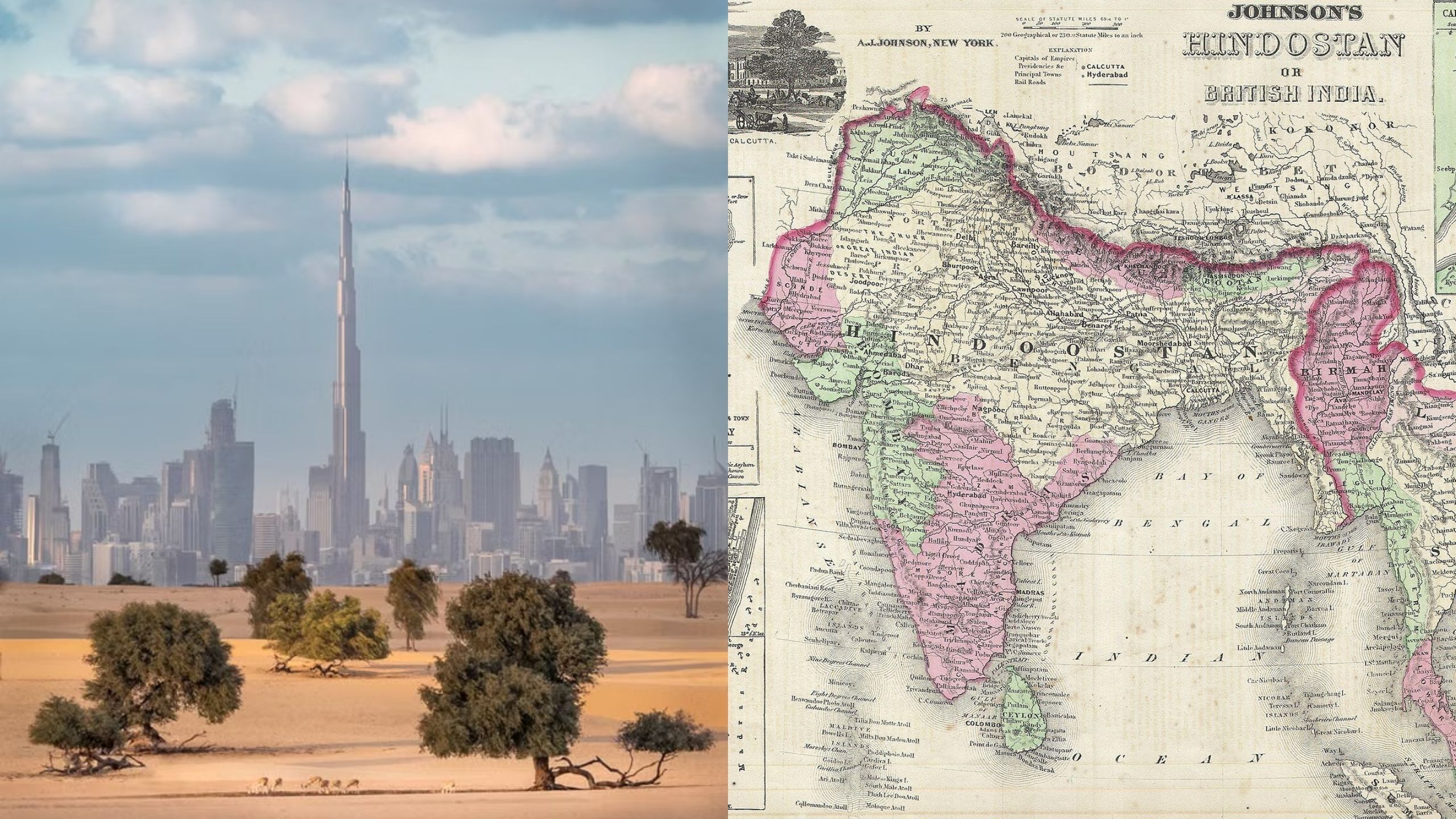
What if Dubai had become part of India? In 1947, that possibility was reportedly considered as Britain prepared to leave the subcontinent. The Gulf had deep administrative ties to British India, with Indian currency, troops and passports in use across the region. One decision on April 1, 1947, helped set the map we know today. The borders changed. The historic ties never completely disappeared. .
For the millions of Indians and Pakistanis who live in the city, work there, and travel back and forth between South Asia and the Gulf, the idea can sound almost absurd: there was a moment when Dubai, Doha and even Oman might have ended up on the other side of the map — as part of India or Pakistan.
Yet that possibility was once discussed.
Anandabazar, one of India’s leading Bengali-language newspapers, reported on August 14, 2026, that Dubai could once have become part of India, drawing on historian and author Sam Dalrymple’s book Shattered Lands: Five Partitions and the Making of Modern Asia.
It is a striking thought. Look at Dubai now: the towers, the vast shopping malls, the extraordinary wealth, the constant movement of people from almost every corner of the world. The city has become synonymous with modernity and excess. It is home to the world’s tallest tower and is among the world’s largest and most populous cities.
But Dubai’s history did not begin with the skyline.
For much of the early 20th century, the Gulf was tied administratively to British India in ways that are barely remembered today. Indian currency circulated there. Indian troops were stationed there. Indian passports were issued there. And officials in Delhi, rather than London, played a central role in governing parts of the region.
That history makes the events of 1947 particularly important.
When Britain prepared to leave the Indian subcontinent, the question was not simply what would happen to India and Pakistan. There was also the awkward question of what would happen to the Gulf territories that had long been connected to British India.
According to Dalrymple, the British considered whether those territories might be transferred to the government of India after independence. The idea, however, attracted little enthusiasm.
One British official in Tehran was reportedly struck by what he described as an “apparent consensus” among officials in Delhi that the former Persian Gulf was not of much interest to the Indian government.
There was a practical objection, too. William Hay, who lived in the Gulf region, argued that “It would clearly have been inappropriate to hand over responsibility for the Gulf Arabs to the Indians or Pakistanis.”
In retrospect, that sentence carries rather more weight than it probably seemed to at the time.
On April 1, 1947, several months before India and Pakistan became independent, the Gulf Arab territories were formally separated from British India. When independence arrived on August 15, they were no longer part of the political question facing the new Indian state.
The decision looks almost mundane on paper. Its consequences were anything but.
Dalrymple points out that, at the beginning of the 20th century, nearly one-third of the Arab Gulf region was administered as part of the British Indian Empire. He describes a system in which the Indian Political Service oversaw affairs, the Indian Army provided security and the territories ultimately answered to the Viceroy of India.
He cites the Interpretation Act of 1889, under which these territories were legally considered part of India.
The connections went further than government offices and soldiers.
Abu Dhabi appeared on official lists of India’s princely states. Viceroy Lord Curzon even proposed treating Oman as a princely state of British India.
In Aden, in modern-day Yemen, Indian passports were in use. The city was administered as part of the Bombay Presidency and functioned as India’s westernmost port.
Dalrymple offers one particularly revealing example. “Everyone in British India was eligible for an ‘Indian Empire Passport,’” he wrote. After the Balfour Declaration, a Jewish woman from Yemen seeking to travel to Jerusalem had to use an Indian passport because, having been born in South Yemen, she was legally an Indian.
That sounds strange now because the political geography we know has become so deeply embedded in our minds. But borders that appear permanent are often anything but.
When Mahatma Gandhi visited Aden in 1931, he reportedly encountered young Arabs who identified themselves as Indian nationalists. The connection was not merely something imposed by officials in distant offices; for some people, it had become part of how they understood their own political identity.
Then came Partition.
Britain’s departure created a problem across the subcontinent and beyond it. India had 565 princely states that were not technically part of British India. Their future was uncertain. Had they all chosen independence, the map of India would have looked radically different.
Something similar, in a sense, was possible in the Gulf.
But the Gulf sheikhdoms ultimately followed a different path. Dubai and Doha emerged as separate Gulf states, remaining under British protection until 1971. The opportunity — if that is what it was — for them to become part of India or Pakistan disappeared.
It is tempting to turn this into an exercise in counterfactual fantasy.
Imagine Dubai as an Indian city. Its oil wealth and strategic port under Indian control. No visa required for an Indian traveller. A city of extraordinary wealth at the western edge of the country, reshaping India’s economy and its position in the Middle East.
Enjoying this article?
Subscribe to get more stories like this delivered to your inbox.
There would have been enormous consequences.
India’s influence in West Asian geopolitics might have been far greater. Its economic power could have developed along a very different trajectory. The relationship between South Asia and the Gulf, already deeply intertwined through migration, trade and remittances, might have taken on an entirely different political character.
But there is another way of looking at the story.
The important lesson is not that Dubai was somehow “meant” to belong to India. It was not. Nor is it useful to pretend that the Gulf’s eventual independence was simply an accident waiting to be corrected.
What matters is how contingent the political map of 20th-century Asia really was.
The borders that now seem obvious were negotiated, inherited, disputed and, sometimes, settled by decisions that attracted little public attention at the time. In 1947, officials were dealing with an empire coming apart, governments being created, territories being transferred and a region facing profound uncertainty.
A decision made on April 1 may not have looked historic to the people making it.
Nearly eight decades later, it looks rather different.
Today, around two million Indians live in Dubai. They are part of the city’s economy, its neighbourhoods, its businesses and its everyday life. In a way, the old connection that disappeared from the political map never entirely disappeared from human lives.
The borders changed. The movement of people did not.
And perhaps that is the most interesting part of this forgotten history. The question is not really whether Dubai could have been Indian. The question is how close the modern map of Asia came to looking completely different — and how easily we forget that the borders we now take for granted were once anything but inevitable.
Contributing writer at The Independent News