
The 2040 Power Race: America, China and India Fight for Global Influence
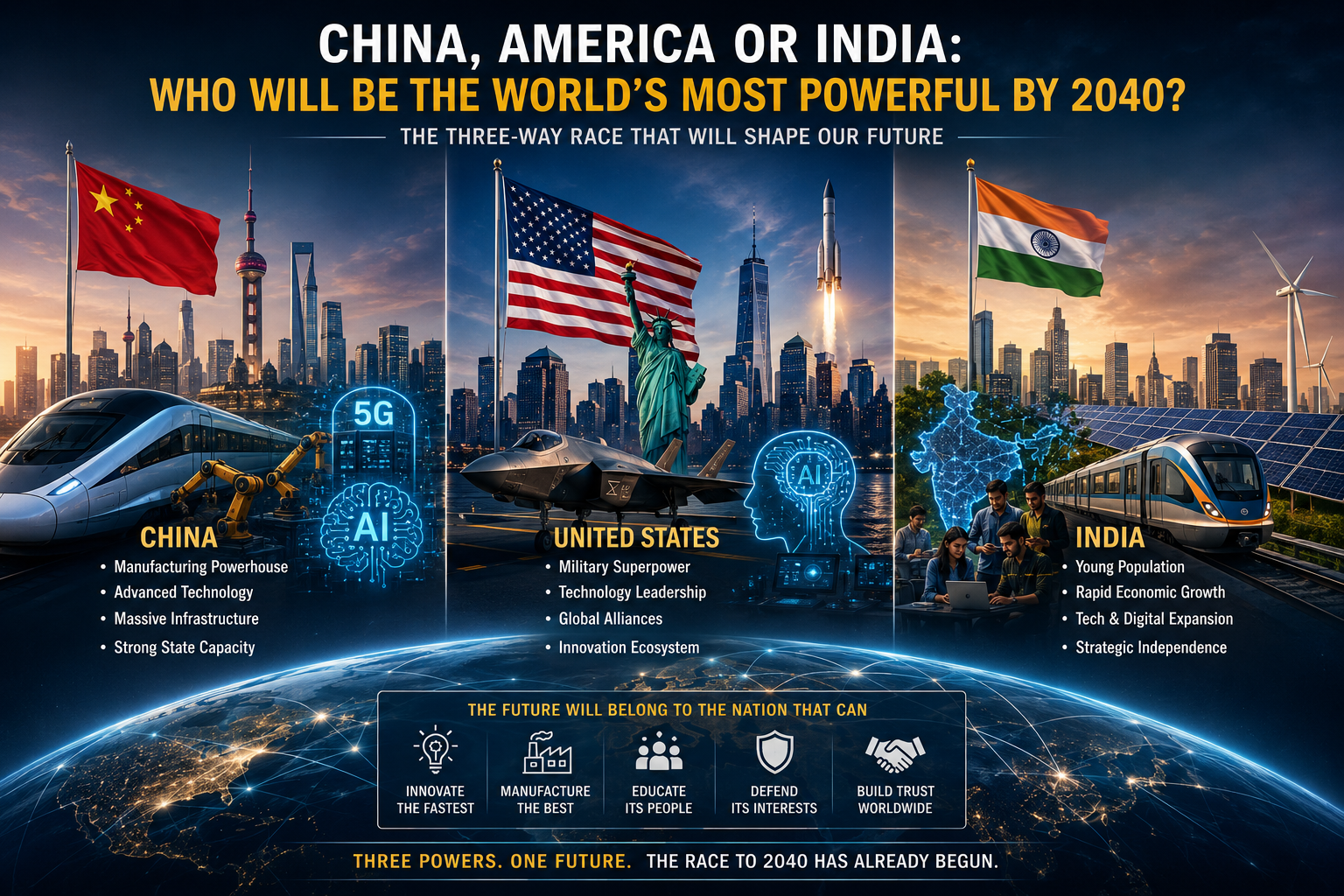
China, America or India—who will shape the world by 2040? The race for global power is no longer just about armies or economies. AI, technology, energy, demographics and strategic influence could determine who leads the next world order. Three powers. One future. The race to 2040 has already begun.
The contest for global supremacy is already underway—but the winner will not necessarily be the country with the biggest army or economy
The question sounds like the sort of geopolitical parlour game that invites a simple answer: by 2040, will the United States, China or India be the world’s most powerful country?
It is, however, the wrong kind of simple question.
Power is changing. The country that dominates the next generation will not necessarily be the one with the largest military, the biggest population or even the highest gross domestic product. The decisive advantage may belong to whichever nation can combine economic strength, technological innovation, artificial intelligence, industrial capacity, military capability, energy security and human capital more effectively than its rivals.
That puts three countries at the centre of an extraordinary strategic contest.
America has the technological and military advantages. China possesses extraordinary industrial and economic scale. India has demographic weight, a rapidly expanding economy and growing technological and geopolitical influence.
By 2040, the balance between them could determine much of the shape of the international order.
America still has the strongest hand
The United States begins this race with advantages that are difficult to replicate.
Its military has global reach. Its technology companies operate at the frontier of artificial intelligence and advanced computing. Its universities and research institutions remain major centres of innovation. Its aerospace and defence industries possess capabilities that few countries can match.
But American power extends beyond hardware.
Washington has spent decades constructing alliances and strategic partnerships across Europe and the Indo-Pacific. The global role of the dollar gives the United States an additional source of influence, while American companies remain deeply embedded in the world's technology and financial systems.
Yet there is no guarantee that today's advantages will automatically translate into dominance in 2040.
Political polarisation, fiscal pressures and domestic divisions could constrain America's ability to pursue a coherent long-term strategy. Its greatest challenge may therefore be less about defeating an external rival than maintaining the political, economic and technological conditions that have historically made American power so formidable.
If the United States continues to attract talent, innovate faster than its competitors and maintain its alliance network, it could remain the world's most influential power for decades.
But history offers few examples of permanent supremacy.
China is building power on an industrial scale
If America's greatest advantage is its technological ecosystem, China's may be its ability to manufacture and deploy at extraordinary scale.
China has become a central player in global manufacturing and has developed major capabilities in electric vehicles, batteries, solar energy, infrastructure and advanced industrial production.
It is also investing heavily in artificial intelligence, telecommunications, space technology and modern military capabilities.
This combination matters.
A country that can both develop strategic technologies and manufacture them at enormous scale possesses a formidable advantage. In any future competition over advanced industries, energy systems or defence production, industrial capacity could prove as important as scientific discovery itself.
Yet China's trajectory is not without risks.
An ageing population, declining birth rates, debt and property-sector pressures present long-term challenges. At the same time, tensions with the United States are increasingly affecting trade, technology and access to strategically important components.
China's challenge, therefore, is not simply to become richer.
It must turn economic and industrial scale into sustainable innovation while navigating demographic pressures and an increasingly competitive international environment.
India could be the most consequential surprise
India is perhaps the most difficult country to assess because its greatest potential lies in what it could become rather than simply what it is today.
It does not yet possess America's global military reach or China's manufacturing capacity. But it has something both countries would value enormously: a huge population and a comparatively young demographic profile.
That alone does not guarantee great-power status.
A young population becomes an economic advantage only when people are educated, healthy, skilled and employed productively. If India can achieve that transformation while continuing to expand its infrastructure, technology sector and economy, its influence could rise dramatically.
India's strategic position also gives it room to manoeuvre.
It is strengthening ties with the United States and other Western powers while maintaining long-standing relations with Russia. It is expanding its role in the Indo-Pacific and building relationships across the developing world.
That diplomatic flexibility could become one of its greatest assets.
India may not need to choose between the existing centres of power. It could instead become one of them.
The real battle may be fought by machines
The most important contest of the next 15 years may not take place in the traditional military arena.
It may take place inside laboratories, data centres, semiconductor factories and technology companies.
Artificial intelligence is rapidly becoming a strategic resource. The countries that can develop advanced AI, secure computing capacity, produce sophisticated semiconductors and deploy those technologies across industry, defence, healthcare and government could gain an advantage extending far beyond the technology sector.
This is why the rivalry between Washington, Beijing and New Delhi should not be viewed simply through the traditional lens of military power.
The critical questions are becoming different.
Who can educate and retain the best scientists?
Who can build the most advanced computing infrastructure?
Who can secure the supply chains behind critical technologies?
Who can turn research into mass-market products?
And who can integrate new technology into the wider economy quickly enough to make it a source of national power?
The answers could matter more in 2040 than conventional rankings of military strength.
Energy will decide who can afford the future
There is another competition running alongside the technology race: energy.
A modern economy cannot function without reliable energy, and the next generation of industries will require enormous amounts of it.
Nuclear power, solar energy, batteries, electric vehicles and emerging energy technologies could therefore become central to economic and strategic competition.
The country that can secure abundant and affordable energy while developing the technologies of the next energy era will have a major advantage.
This is particularly important because energy security and technological security are increasingly becoming inseparable.
India has people. China has scale. America has networks.
The three countries possess different forms of power.
America's strength lies in its combination of technology, military capability, capital, institutions and alliances.
China's advantage lies in industrial capacity, economic scale, infrastructure and strategic state capacity.
Enjoying this article?
Subscribe to get more stories like this delivered to your inbox.
India's opportunity lies in its population, economic growth, technological potential and increasingly important geopolitical position.
But none of these advantages is permanent.
China's demographic challenge could become a serious economic constraint. India's population could become a burden rather than a dividend if sufficient jobs, education and productivity do not follow. America's technological lead could narrow if political dysfunction or restrictions on talent and innovation weaken its competitive edge.
The winner, therefore, will not simply be the country with the most resources.
It will be the country that converts resources into power most efficiently.
The myth of a single winner
There is a natural desire to identify one future superpower.
But the world of 2040 may not work that way.
It is entirely possible that America will remain the leading military and technological power, China will remain the dominant industrial competitor, and India will emerge as a major economic and demographic force.
The result could be a more complicated—and potentially more unstable—three-power world.
Influence may shift from one issue to another.
America could retain an advantage in military reach and cutting-edge innovation. China could dominate important manufacturing and energy technologies. India could become increasingly important because of its workforce, market and strategic position.
In such a world, asking which country is “number one” may become less useful than understanding where each country holds leverage.
The 2040 test
Ultimately, the future will be determined not by population statistics or military rankings alone, but by national adaptability.
For America, the test is whether it can preserve its technological lead, attract talent and maintain its global alliances while overcoming internal divisions.
For China, the test is whether it can sustain economic dynamism, overcome demographic pressures and turn industrial strength into enduring technological leadership.
For India, the test is perhaps the most ambitious of all: whether it can transform demographic scale into educated, skilled and productive human capital while building the institutions and infrastructure required to support a major global economy.
There is no predetermined winner.
And that is precisely what makes the coming years so consequential.
The world is moving towards a period in which artificial intelligence, advanced manufacturing, energy technology, demographics and geopolitical alliances will increasingly determine national power.
The country that understands this transformation—and adapts to it fastest—may have the strongest claim to leadership in 2040.
So, will it be America, China or India?
The answer may not be decided by who is strongest today.
It will be decided by who is best prepared for tomorrow.
Contributing writer at The Independent News