
When Two Voices Are All That Remain: The Fight to Save Bangladesh’s Kharia Language

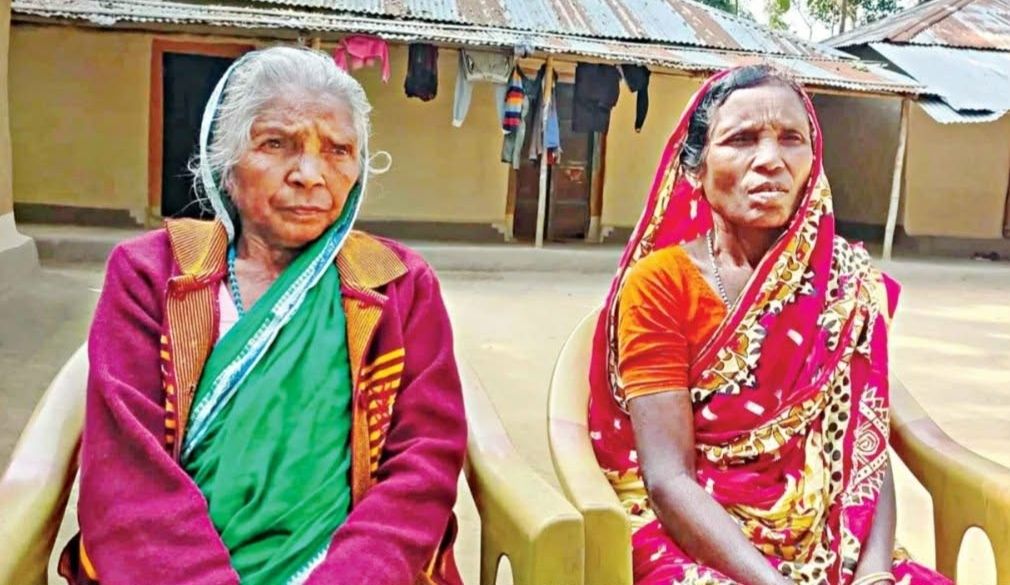
Bangladesh’s Kharia community is facing a silent cultural crisis. Only two elderly women—Christina Kerketta and Veronica Kerketta—are believed to remain fluent in the Kharia language. When their voices fall silent, a centuries-old linguistic heritage may disappear with them. This is the story of Bangladesh’s last two Kharia voices—and a call to preserve a language before it is too late. The two sisters, Christina Kerketta (75) and Veronica Kerketta (80), are believed to be the last fluent speakers of the Kharia language in Bangladesh. They live in Barmachhara Tea Garden in Sreemangal, Moulvibazar.
Bangladesh’s Last Two Voices: What the Kharia Language Is Telling the World
Sangram Datta:
For most of the world, the disappearance of a language is an invisible tragedy. There is no headline when the last fluent speaker stops speaking. There is no ceremony when the final words of a centuries-old linguistic tradition fall silent. Yet somewhere in northeastern Bangladesh, that moment may now be approaching.
This is the story of the Kharia people living in Bangladesh—and, more urgently, of a language that may soon have no living speakers left in the country.
In the tea gardens and hilly areas of Sylhet Division, a small but historically significant Kharia community has survived for generations. Their ancestors came to what is now Bangladesh during the British colonial period, recruited from different parts of India to work in the tea industry. They settled in tea gardens across Moulvibazar, Habiganj and Sylhet.
Today, the community remains, but its language is disappearing.
Only two elderly women in Bangladesh are now able to speak Kharia fluently: 75-year-old Christina Kerketta and 80-year-old Veronica Kerketta, both from the Barmachhara Tea Garden in Sreemangal, Moulvibazar.
Their story should concern not only Bangladesh but anyone who believes that cultural diversity is part of humanity’s shared heritage.
A community that survived, but a language that did not
The Kharia are an Austroasiatic indigenous people of east-central India. Their language belongs to the Austroasiatic family and is closely associated with the broader history of the Munda peoples.
Linguist Paul Sidwell has argued that Munda languages arrived on the coast of Odisha from Southeast Asia approximately 4,000 to 3,500 years ago. Over centuries, Austroasiatic-speaking populations moved through the Indian subcontinent and interacted extensively with local communities.
The Kharia language subsequently developed among Munda populations living in the forests of areas that are now Jharkhand, Chhattisgarh, Odisha and parts of West Bengal, roughly between 2000 and 1500 BCE.
This is therefore not simply the story of a small contemporary language. It is connected to a much older human history.
But history alone cannot keep a language alive.
In Bangladesh, the Kharia community is spread across 41 settlements in tea-garden areas of Sylhet Division. Estimates put the community’s population at around 5,700, while Bangladesh’s 2022 census recorded approximately 3,099 Kharia people. Unofficial estimates place the population at around 6,000.
Yet population survival and language survival are two different things.
A community can continue to exist while its ancestral language disappears within a few generations.
That is precisely what is happening to the Kharia in Bangladesh.
When the last speakers disappear
The central question is no longer whether Kharia is under pressure. It clearly is.
The question is what happens when Christina Kerketta and Veronica Kerketta are no longer here.
According to the information available about the community, there may be no other living fluent Kharia speakers in Bangladesh after their deaths. If that happens, Kharia will become completely extinct as a living language in this country.
This distinction matters.
A language can survive in an archive, a dictionary or an academic paper. But that is not the same as a language being spoken naturally by a community.
Languages carry much more than vocabulary. They contain ways of describing nature, relationships, memory, belief, humor and grief. They preserve cultural knowledge that may never have been written down.
When a language disappears, an entire way of understanding the world can disappear with it.
For Bangladesh, the impending loss of Kharia is therefore not merely a minority-community issue. It is a national cultural loss.
Why did Bangladesh reach this point?
The reasons are complex, but they are not mysterious.
The younger generation increasingly speaks Bangla, Sadri, Hindi or other local languages. Education takes place in Bangla, while Kharia has no institutional education system, textbooks or official recognition in Bangladesh.
There is also no widely established written form or recognized alphabet for Kharia in Bangladesh. The language has remained primarily oral.
This creates a devastating cycle.
Children do not learn the language because it has little institutional or economic value. Because fewer children learn it, fewer adults use it. As the number of speakers declines, the language becomes even less useful in everyday life. Eventually, the language survives only in the memories of the oldest generation.
The weakening of cultural connections with Kharia communities in Jharkhand and Odisha has also reduced opportunities for linguistic and cultural exchange.
Poverty, livelihood pressures and social and educational expectations add further pressure.
There is another, more difficult issue: identity.
When minority communities fear discrimination or believe that their traditional identity may limit their opportunities, younger people may choose to hide or abandon aspects of that identity. Language can become one of the first casualties.
None of this means that Kharia people have rejected their heritage. Often, the opposite is true. People may deeply value their heritage while simultaneously recognizing that speaking a minority language offers few practical advantages in education, employment or public life.
That is the cruel dilemma faced by many endangered-language communities around the world.
Bangladesh is not alone—but it has a unique responsibility
The Kharia people are not confined to Bangladesh.
In India, their population is much larger. The 2011 Indian census recorded more than 420,000 Kharia people across several states, including Jharkhand, Odisha and West Bengal. Jharkhand alone recorded 234,366, while Odisha recorded 144,179 and West Bengal 38,280.
Kharia communities also live in other parts of India.
The three broad Kharia subgroups are Dudh Kharia, Dhelki Kharia and Hill Kharia. Dudh Kharia and Dhelki Kharia speak Kharia, while Hill Kharia speak an Indo-Aryan language known as Kharia Thar.
In India, Kharia does not have a separate indigenous script either. Devanagari is primarily used in Jharkhand, while Latin script is used in Odisha.
This makes Bangladesh’s situation particularly important. The country does not need to invent a language from nothing. It needs to document, preserve and reconnect with a linguistic tradition that still survives—albeit through only two elderly fluent speakers.
That window is rapidly closing.
Preservation must begin before the last voice falls silent
There is an understandable tendency to think that language preservation begins with dictionaries and grammar books.
Those are important. But preservation should begin with people.
The first priority should be to record Christina Kerketta and Veronica Kerketta while they are still able to speak. Their vocabulary, pronunciation, stories, songs, expressions, family histories, traditional knowledge and everyday conversations should be documented in high-quality audio and video.
Researchers should work with the community—not simply study it.
The recordings should then be preserved in accessible digital archives, with copies maintained by Bangladeshi cultural and academic institutions and, where appropriate, international language-preservation organizations.
A Kharia-Bangla vocabulary and basic linguistic documentation could become an important foundation for future generations. Oral histories could preserve knowledge that cannot be recovered once the last speakers are gone.
But documentation alone will not revive a language.
If younger Kharia people want to learn it, they need opportunities to do so. Community-based language classes, children's materials, cultural programs and digital educational resources could create a bridge between the surviving speakers and a younger generation.
Cross-border cultural links with Kharia communities in India could also play an important role.
The objective should not be to isolate Kharia people from Bangla or other languages. Multilingualism is not the enemy. A Kharia child can learn Bangla, English, Hindi or Sadri and still retain the language of their ancestors.
Enjoying this article?
Subscribe to get more stories like this delivered to your inbox.
The real goal should be to ensure that modernization does not require cultural erasure.
The meaning of a language
The Kharia community also carries a rich cultural tradition.
Its festivals include Sarhul, a spring celebration deeply connected to nature and gratitude, in which sal flowers are regarded as symbols of life and prosperity. The community also observes the Baha festival.
Kharia people are known for their traditional dances, including Hariyo, Kinvar, Halka, Kudhing and Jadhura. Their cultural practices reflect a close relationship with land, forests and nature.
These traditions are not separate from language.
Songs require language. Stories require language. Traditional knowledge requires language. Cultural memory is often transmitted through language.
That is why saving Kharia cannot mean preserving only artifacts, photographs or costumes while allowing the language itself to disappear.
A museum can preserve an object.
Only people can keep a language alive.
A test of Bangladesh’s commitment to diversity
Bangladesh is internationally known for its linguistic history. The country’s national identity is deeply connected to the defense of language and linguistic rights.
That history gives Bangladesh a special reason to pay attention to the Kharia community.
The country’s commitment to linguistic diversity should not end with the majority language.
The Kharia people are part of Bangladesh’s social and cultural landscape. Their presence in the country is rooted in the history of the tea industry and in generations of settlement. Their story is therefore also part of Bangladesh’s own history.
If the last two fluent Kharia speakers die without their language being adequately documented, future generations may ask why nothing was done when there was still time.
That question would be difficult to answer.
Two women, and a responsibility larger than two lives
Christina Kerketta and Veronica Kerketta should not be viewed merely as the “last two speakers” of an endangered language.
They are living repositories of memory.
Within their speech may exist words, expressions, stories and cultural knowledge that cannot be reconstructed once they are gone.
Their lives remind us of an uncomfortable truth about endangered languages: extinction often does not arrive dramatically. It happens quietly, inside families, as children stop learning the language their grandparents once spoke.
Bangladesh still has a narrow opportunity to prevent the Kharia language from disappearing without a trace.
The government, universities, linguists, cultural organizations, indigenous-community representatives and international language-preservation institutions should work together urgently. The community itself must remain at the center of that effort.
The goal should not be to freeze Kharia in the past. It should be to give the language a future.
For international readers, the Kharia story is a reminder that linguistic extinction is not an abstract global statistic. It can happen in a tea garden, in a family home, in a conversation between two elderly women.
And when those voices fall silent, humanity loses more than words.
It loses a way of remembering the world.
Contributing writer at The Independent News