
Passport rankings reveal shifting global mobility as Singapore takes top spot

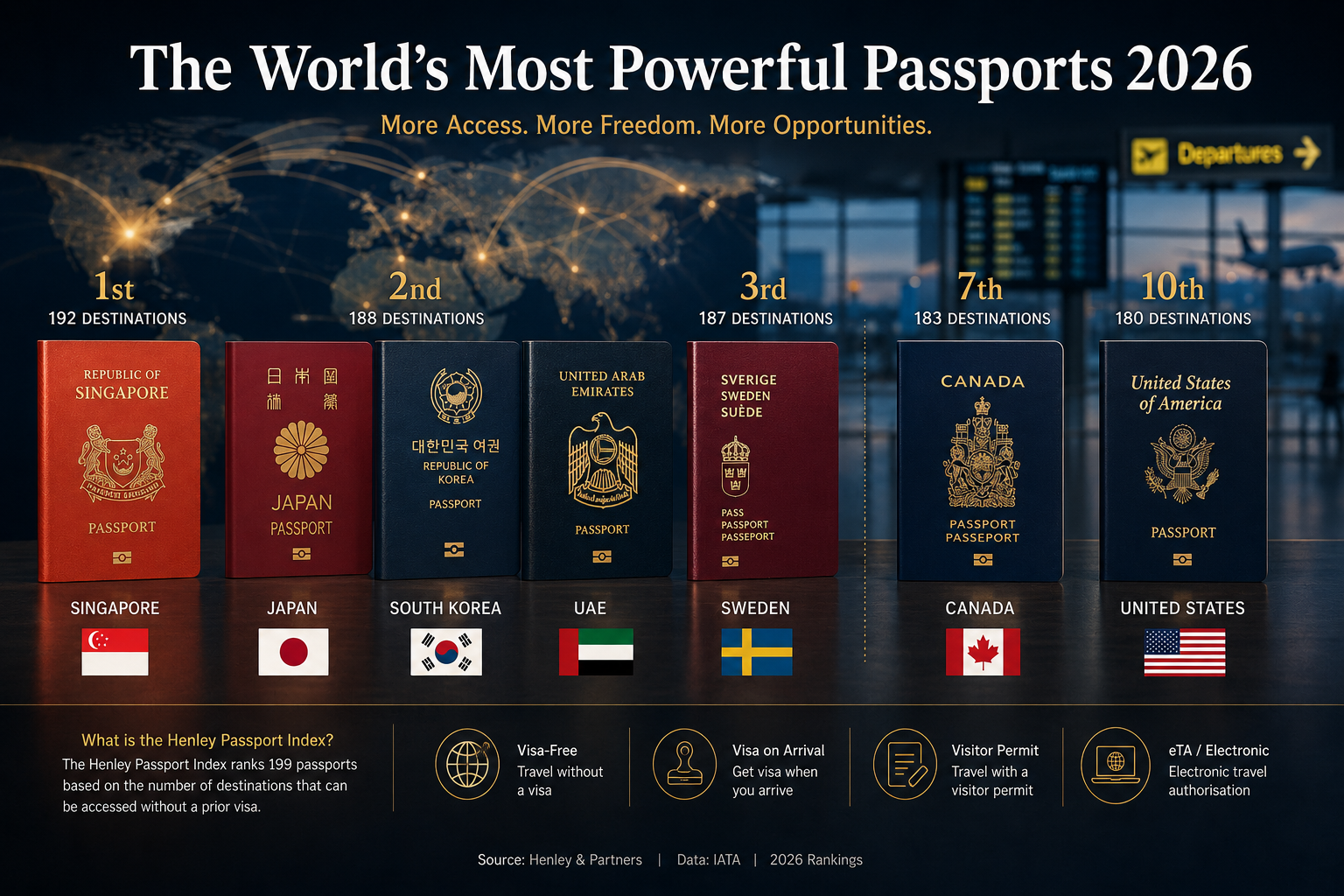
A passport is more than a travel document—it is a reflection of diplomatic trust, international relationships and a country’s place in the world. In 2026, Canada ranks seventh globally with access to 183 destinations, moving ahead of the United States. Bangladesh ranks 95th with access to 37 destinations, highlighting a very different reality of global mobility.
At an airport, two travellers can stand side by side with the same destination in mind and yet experience entirely different journeys before they ever leave the terminal.
One may walk confidently towards immigration, passport in hand, knowing that entry will be relatively straightforward. The other may have spent weeks collecting documents, arranging a visa, proving accommodation, showing bank statements and preparing an invitation letter. The difference may not be wealth, education or even the purpose of travel. It may simply be the passport in their hand.
That is what makes passport rankings more than a list of numbers. They offer a revealing snapshot of how countries are perceived, how they relate to one another and how easily their citizens can move through an increasingly interconnected world.
The latest 2026 Henley Passport Index offers an especially interesting example. Canada ranks seventh, with its citizens enjoying access to 183 destinations without a conventional visa in advance. The United States, by contrast, ranks 10th, with access to 180 destinations.
Three destinations may not sound like a dramatic difference. For an individual traveller, however, the significance can be much greater. Behind every visa waiver is a diplomatic decision, a security assessment, a bilateral understanding or years of negotiations between governments.
Canada's position is therefore noteworthy not simply because it has overtaken the United States. It is noteworthy because passports are, in many ways, diplomatic documents in disguise.
The index, compiled by Henley & Partners using primary data from the International Air Transport Association, covers 199 passports and 227 travel destinations. Its scoring system considers destinations that can be accessed without a conventional visa obtained in advance, including visa-free entry, visa-on-arrival arrangements, visitor permits and certain electronic travel authorisations.
Singapore sits at the top in 2026, with access to 192 destinations. Japan, South Korea and the United Arab Emirates jointly occupy second place with 188, while Sweden follows with 187. Canada is part of the group sharing seventh place with access to 183 destinations.
The ranking also tells a more complicated story about the United States and Canada.
In 2014, the United States was the world's strongest passport, while Canada ranked second—its highest position to date. Canada has not suddenly become a dramatically more mobile country while America has become dramatically less so. Much of the change reflects the pace at which other countries have expanded their visa-waiver networks, particularly across Europe and Asia.
That distinction matters. Rankings can create the impression of winners and losers, but passport power is not a fixed measure. It changes as diplomatic relationships change.
And that brings us to a more uncomfortable question: why are some passports so much more powerful than others?
The answer cannot simply be that some countries are richer.
Passport strength is influenced by diplomatic relations, reciprocal visa arrangements, border security and the confidence governments place in one another's citizens. A country that is seen as stable, cooperative and predictable may find it easier to negotiate broader travel access for its citizens. In that sense, a passport reflects not only the individual who carries it but also the international reputation of the state that issued it.
The contrast within South Asia is striking.
The Maldives has the region's strongest passport, ranking 52nd globally with access to 93 destinations. India ranks 81st with access to 55 destinations, while Sri Lanka ranks 94th with access to 39.
Bangladesh ranks 95th, with access to 37 destinations. Nepal stands at 96th and Pakistan at 98th. Afghanistan occupies the bottom of the global ranking.
Yet Bangladesh's current position looks particularly striking when viewed against its own past.
In 2006, Bangladesh ranked 68th globally, ahead of India, which stood at 71st. Pakistan had access to only 17 destinations at the time. Nearly two decades later, Bangladesh ranks 95th. It fell as low as 108th in 2021 and has since recovered somewhat, but it remains far from its 2006 position.
This is not merely a story about lost travel opportunities. It raises broader questions about Bangladesh's diplomatic reach, international relationships and ability to secure reciprocal mobility arrangements.
For ordinary citizens, however, these geopolitical questions are experienced in very practical ways.
A passport holder may face additional expenses, paperwork, uncertainty and the risk of rejection simply because of nationality. A business traveller may need to delay a meeting. A student may have to navigate a complicated application process. A family planning a holiday may have to provide financial documents and wait weeks for approval.
The passport becomes a form of invisible privilege—or an invisible barrier.
At the same time, passport rankings require a degree of caution in interpretation. Being counted among 183 destinations does not mean a Canadian traveller can simply arrive anywhere without conditions. Some countries provide genuine visa-free access; others require visas on arrival or electronic authorisation.
The distinction is important.
The United States requires ESTA for eligible visa-exempt travellers. The United Kingdom uses ETA, while Canada uses eTA. These systems do not necessarily require a traditional visa application through an embassy, but they can still involve online applications, approval and fees. Airlines may also refuse boarding when required authorisation has not been obtained.
Ultimately, no passport guarantees admission. Border officials retain the final authority, and immigration requirements can change.
Enjoying this article?
Subscribe to get more stories like this delivered to your inbox.
For travellers, the practical lesson is simple: a passport ranking should never replace checking the official immigration rules of the destination country before booking a flight.
But for policymakers, the lesson is much bigger.
If a passport is partly a measure of diplomatic confidence, then improving its strength should not be viewed merely as a race up an international league table. It should be treated as part of a country's broader foreign-policy strategy.
Every new visa-waiver agreement can reduce friction for students, tourists, workers and businesses. Every improvement in international trust can expand opportunities for citizens. Conversely, a decline in travel access can be a warning sign that a country's international relationships are not producing the benefits they once did.
Canada's seventh-place ranking is therefore significant beyond the three destinations separating it from the United States. It demonstrates how mobility can reflect a country's changing position in the international system.
Bangladesh's experience offers the other side of the story. Its decline from 68th place in 2006 to 95th in 2026 is a reminder that international mobility cannot be taken for granted. Progress in economic development does not automatically translate into greater passport power. Nor does a country's past diplomatic standing guarantee its future.
A passport is a small booklet, but it carries a surprisingly large political message.
Its pages contain a citizen's identity, but the access those pages provide is shaped by diplomacy, trust, security and international cooperation. The strength of a passport is, ultimately, a reflection of how easily a country can build relationships beyond its borders.
That is why the world's passport rankings deserve to be read as more than travel statistics.
They are, in miniature, a map of global confidence.
And sometimes, the distance between two passports tells us more about the changing world than the distance between two countries on an actual map.