
Keeping one-fifth of humanity warm

By Niu Honglin
Winter has a way of stripping systems down to their essentials. Pipes freeze. Power lines snap. Heaters become the most important appliance in the house. When I started researching this episode of the podcast, I kept coming back to a simple question that feels increasingly global: what actually keeps people warm when the weather turns brutal—and what fails when it doesn’t?
This winter, that question has been impossible to ignore. Across the Northern Hemisphere, cold waves swept through Russia, Europe, Japan, the United States—and China. But the scale of the challenge in China is different. Keeping the lights on and homes heated here doesn’t mean protecting a city or a region. It means doing so for nearly one-fifth of humanity, across climates that range from sub-zero Arctic winters to tropical heat.
That alone makes China’s winter energy story worth paying attention to. But as I dug deeper for the podcast, I realized something else: winter heating is one of the clearest windows into how a country’s energy system, governance priorities, and how the social contracts actually work.
Heating one-fifth of humanity
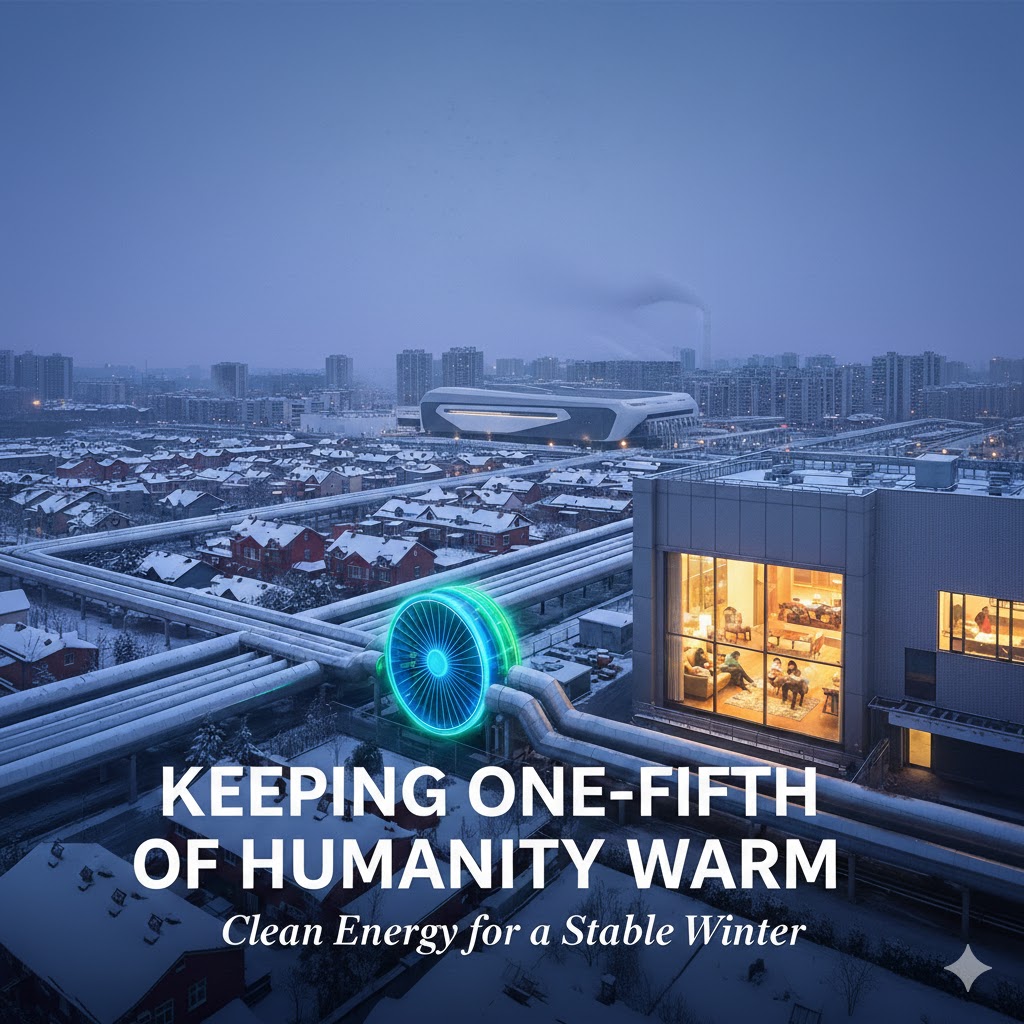
China runs the largest district heating system on Earth. In northern cities, winter heating is a coordinated operation. Thousands of kilometers of pipelines move heat from power plants into homes, offices, schools, and hospitals. The heated floor area approaches nine billion square meters, roughly a quarter of all building area in the United States.
One engineer I spoke to described northern cities as operating like “a giant, precise machine.” Waste heat from power generation is captured and redistributed at scale. This “big system” approach has real advantages: efficiency per unit of energy, operational stability, and the ability to respond centrally when demand spikes.
But that system doesn’t exist everywhere. China’s famous north–south divide still defines how people stay warm.
A policy line that still shapes daily life
In the 1950s, policymakers drew a line along the Qinling Mountains and Huaihe River. North of it, where average winter temperatures stay below 5°C for extended periods, centralized heating qualified as a public service. South of it, it didn’t.
That decision still echoes today. In northern cities, heat arrives through radiators on a fixed seasonal schedule—though that schedule is becoming more flexible as weather patterns change. In the south, most households rely on air conditioners, electric heaters, or other individual solutions. Winters are milder there, but cold, damp spells can still feel harsh indoors.
This isn’t just about comfort. It’s about infrastructure path dependence. Once systems are built—or not built—they shape costs, expectations, and vulnerabilities for decades.
Why extreme cold doesn’t automatically become a disaster
One thing that stood out to me while researching this episode is how heating is framed politically in China. Residential heating is treated as a “livelihood bottom line.” During extreme cold snaps, energy companies are required to prioritize households over industrial users. Even when global natural gas prices spike, residential heating prices are kept stable.
Then there’s the quiet role of buildings themselves. Northern cities follow strict insulation standards—thick exterior walls, double or triple-pane windows. It’s not flashy, but it matters. Even if heating is interrupted, indoor temperatures typically drop only a few degrees over 24 hours. That buffer buys time.
All of this helps explain why, even during record winter electricity demand earlier this year, China avoided the kind of cascading humanitarian crisis we’ve seen elsewhere.
When cold turns deadly: a contrast with the United States
The contrast became stark in January 2026, during Winter Storm Fern in the United States. As temperatures plunged, at least 100 people lost their lives. Millions were left without power. In some regions, the danger wasn’t just the cold—it was what followed.
Power plants went offline as gas equipment froze. In the South, ice accumulated on trees and power lines not designed to bear the weight, knocking out electricity to entire communities. Homes built for mild winters lost heat quickly. People turned to generators and improvised heating, leading to carbon monoxide poisoning. Medical devices failed when power cut out.
What struck me wasn’t that the U.S. lacked technology or wealth. It was how aging infrastructure, fragmented responsibility, and market signals combined under stress. Much of the grid is decades old. Winterization standards vary by region. Heating and electricity are priced and managed as commodities first, public safety tools second.
Climate scientists warn that this kind of event is becoming the “new normal.” A warming planet can still produce more disruptive winter storms, giving communities less time to adapt.
Cleaning up heat without freezing people
Of course, scale brings emissions. Heating consumes enormous amounts of energy. What surprised me during my research is how many experiments are already underway to clean it up.
Industrial waste heat—energy that used to disappear into the air—is now being captured to warm homes. Geothermal heating is expanding rapidly, from showcase projects like Xiong’an to county-level systems tapping 60-degree underground water. In Hebei province, crop straw is burned in high-efficiency biomass plants, replacing coal and cutting emissions dramatically. In Qingdao city, treated wastewater feeds heat pumps that warm neighborhoods with zero combustion. Even nuclear power is quietly entering the heating mix in places like Haiyan county, where residents talk less about reactors and more about finally taking off their coats indoors.
There’s no single solution. What’s emerging instead is a portfolio approach, shaped by local resources.
More electricity, but a different story
This winter also coincided with a milestone: China’s annual electricity consumption crossed 10 trillion kilowatt-hours for the first time. On the surface, that sounds alarming. But context matters.
Much of the growth is coming from cleaner, higher-value sectors—EVs, data centers, advanced manufacturing—and from electrifying everyday life. Every three units of electricity used in China now include roughly one unit of green power. Demand is rising, but carbon intensity is falling.
A contrast in vulnerability: winter storm fern
Enjoying this article?
Subscribe to get more stories like this delivered to your inbox.
The stability of this system stands in stark, tragic contrast to the "cascading effects" seen in the United States during Winter Storm Fern in January 2026. While China operates its grid as a safety infrastructure, the U.S. crisis exposed the fragility of treating heat as a commodity first and public safety tool second.
The storm claimed dozens of lives as the aging U.S. grid—much of it 50 to 75 years old—buckled under the pressure. In the South, where buildings lack the "thermal coats" of northern climates, the danger wasn't just the cold, but the systemic failure that followed: gas equipment froze, crude oil production dropped by some 15%, and millions were left in the dark as ice snapped lines not designed for the weight. The result was a humanitarian crisis of carbon monoxide poisoning and medical device failures—a sobering reminder that in the face of a volatile climate, the true test of an energy system is whether it holds when people need it most.
Winter tells you what systems really prioritize
Winter doesn’t care about slogans. It tests grids, buildings, markets, and governments all at once. Preparing this podcast episode forced me to look past abstract energy targets and focus on something more tangible: what happens at 3 a.m. when the temperature drops and people just need to stay warm.
China’s approach isn’t something other countries can simply copy. But there are lessons worth borrowing.
One is treating heating and electricity as critical safety infrastructure, not just services. Another is planning for worst-case scenarios, not historical averages. And a third is recognizing that resilience often comes from unglamorous investments: insulation, backup capacity, clear priority rules when supply is tight.
These ideas matter far beyond China.
That’s why we unpacked it in depth on the podcast. Because as winters grow more volatile, the question isn’t whether energy systems are clean or cheap on paper. It’s whether they hold when people need them most.
If this question of winter, energy, and resilience resonates with you, the latest episode of Round Table China takes a closer look at China’s energy story—and why it matters well beyond its borders.
Editor, CGTN