
National Service & Total Defence: Preparing Organisations for an Uncertain World
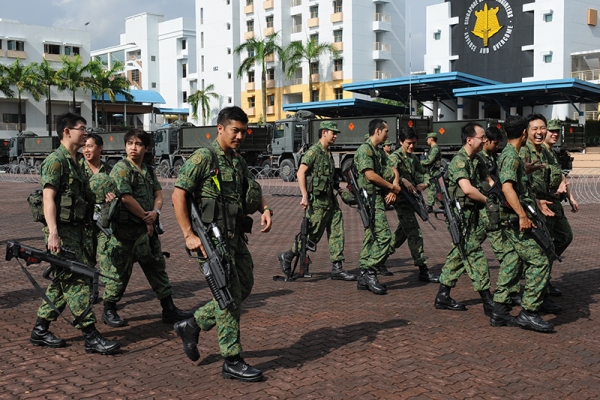
National Servicemen in Singapore's Military
By SUHAIMI ZAINUL-ABIDIN
Every Singaporean man has a National Service (NS) story.
Most of these stories begin the same way — at Pulau Tekong, wide-eyed at enlistment, adjusting to the rhythms of military life. What comes after is often far more varied. A small minority of Singaporeans join the Armed Forces and remain in uniform. Most of us move on to business, healthcare, engineering, teaching, public service and a multitude of other industries. In my own career, leading a company and serving on non-profit boards has given me a front-row seat to how National Service shapes not just individuals, but also the organisations they go on to build and lead. The skills, discipline, and teamwork cultivated do not end at camp; they flow directly into our workplaces, influencing leadership styles, operational performance, and business culture. The trajectories differ - yet NS remains, for many, a defining shared experience. One that shapes our national identity and sense of duty.
It is easy to associate NS with combat training and physical sacrifice. But National Service today is far broader than just military defence. And its success has always depended on more than the individuals who don their pixelated uniforms. We live in a fragile world. One that is defined less by conventional threats and more by cyberattacks, pandemics, economic shocks and societal fissures. That makes the concept of Total Defence more relevant than ever. Similarly, the defence of our nation is not just about soldiers. What matters just as much is the resilience of our systems, institutions and individuals, and the trust between them.
Behind every operationally ready national serviceman (NSman) is a supervisor who approves his leave, a colleague who steps in while he’s away, a mother who does the chores that pile up in his absence, a partner who rearranges childcare schedules, a team that doesn’t blink when camp dates overlap with project deadlines.
These quiet acts of cooperation are a key part of the NS story. They are what make Total Defence a lived, whole-of-society experience.
That is why all of us — leaders in business and in the community— must ask ourselves harder questions. We need to ensure that our organisations and institutions are configured to support, and not just tolerate, NS obligations. Our people policies should reflect an understanding that duty can take many forms. And we need to build an organisational culture that sees service (not just national service, but all forms of community service) as a strength, rather than a liability.
Practical Ways for Organisations to Strengthen Support for NS
We try to do this at Quantedge, where we believe that doing our part for Total Defence is strategically important. It aligns with who we are, and what we stand for, and how we build a strong business. We incentivise good NS performance, such as getting IPPT Gold and receiving NSmen of the Year Awards, with additional cash bonuses. We want our employees to be fit and competent in NS, because that’s good for business. We scrutinise NS contributions and reference checks of new hires to validate their leadership qualities and work ethic. We also recognise the efforts and sacrifices of colleagues who step up and provide cover for on-duty NSmen. Whether we are at peace or at war, we will depend on everyone, regardless of whether they don military uniforms, to keep our respective organisations, businesses and families running smoothly. Life must go on. This is an aspect of national service that we do not pay enough tribute to.
In 2017, two of Quantedge’s senior management staff (both then holding the rank of Captain in the SAF) got called up to attend Command and Staff College. We were then still a small company and losing two leaders of the firm for a period of months would be taxing on the company. But we recognised the call as an honour and privilege for the individuals concerned as well as the company, and they went with the company’s blessings. We’ve designed the company to have the necessary redundancy to handle such situations. They are both holding the rank of LTC (NS) and still serving NS today. The episode also served as a stress test for Quantedge, testing our ability to redistribute responsibility, sustain operations, and trust the systems we had built.
My personal NS experience shaped me as an individual and professional. And it continues to do so. Each time I go for in-camp training, I come back with notes about what I’ve learned in terms of leadership, organisational performance, operations and risk management, insights I apply directly as a business leader. I draw inspiration not just from the army regulars I work with, but also other remarkable NSmen. The context may be different, but some principles are universal, and some models are adaptable. The same applies to anyone else serving national service, in whatever capacity. It is up to the individual to draw lessons and inspiration from the time spent in national service.
You will likely emerge with camaraderie and fond memories, but you can also gain so much more in technical and soft skills.
Cybersecurity Preparedness
As we approach Total Defence Day, it’s worth asking: are our organisations contributing to Total Defence and supporting National Service in an increasingly uncertain world? To mark Total Defence Day in 2025, Quantedge convened a business continuity table-top exercise for the financial sector, under the national Exercise SG Ready campaign. The ground-up initiative involved senior leaders and business continuity teams from eight other asset management, insurance and fintech firms, who joined us for a joint tabletop simulation of a coordinated cyberattack on Singapore’s power grid and banking systems.
The inaugural event was a success, and we sought to build upon that momentum in 2026 by partnering with RSM Singapore and Amova Asset Management (formerly known as Nikko Asset Management) to organise a bigger and bolder exercise — one that will test participants more rigorously. This time, senior executives and business leaders from more than a dozen established investment management companies attended. We also moderated a panel discussion comprising speakers from SGX Group, The Alternative Investments Association (AIMA) and Nexus, MINDEF, which explored decision making under prolonged disruptions, including approaches to weighing difficult tradeoffs in strategic decision making. The goal of these exercises was to test, interrogate, and strengthen our collective ability to respond under pressure, and in doing so, improve the resilience of Singapore’s financial sector.
Enjoying this article?
Subscribe to get more stories like this delivered to your inbox.
This is what Total Defence looks like in practice: different players in the ecosystem coming together, recognising interdependence, testing capabilities and building trust. We must firstly recognise that our collective security — like our collective prosperity — requires broad-based participation, and broad-based support.
We must move beyond the narrow frame of “national service as sacrifice,” and toward a broader ethos of national contribution.
Some serve by carrying arms. Others, by carrying burdens. All deserve recognition.
As we celebrate Singapore’s 60th year of independence, it is worth recalling that NS has underpinned not just our defence posture, but our shared sense of citizenship. In a time where individualism is ascendant globally, NS reminds us that some things must still be done for the common good.
That spirit — we over me — is what will carry Singapore into the next lap.
And for it to endure, every part of society — including employers, educators, civil servants, parents, partners — must do their part to make service possible, meaningful, and respected.
National Service may begin with the uniform, but its strength comes from the organisations and the people who support it.
Suhaimi is the CEO of Quantedge Capital. Prior to this, Suhaimi was a banking & finance partner at Singapore law firm of Allen & Gledhill LLP.
User Contribution