
The Communication Crisis Behind ASEAN Sustainability Ambitions
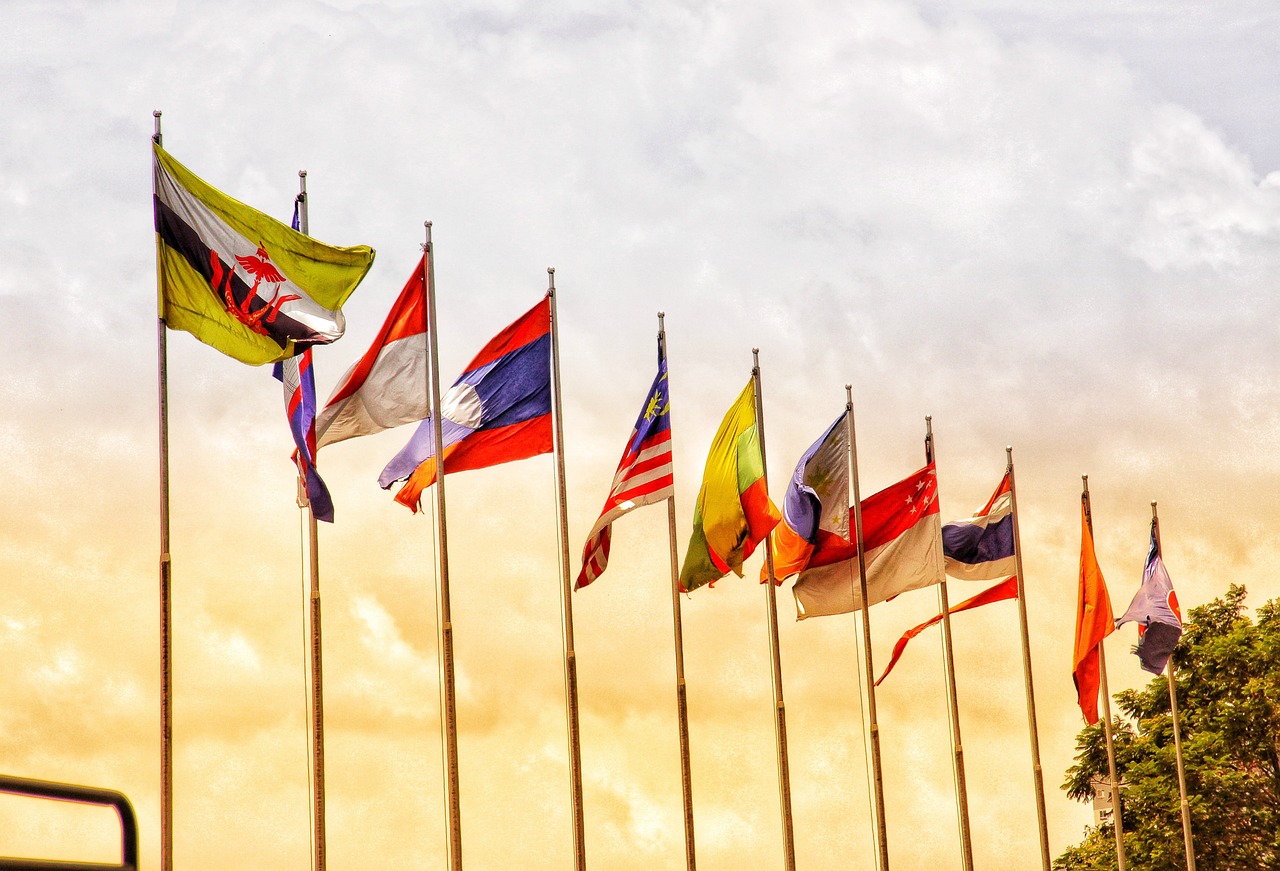
Flags of ASEAN member states
By Muhammad Zulkifli
Environmental crises in Southeast Asia do not recognize national borders. In 2025 ASEAN moved forward with concrete actions aimed at regional sustainability, including the imminent adoption of the ASEAN Declaration on the Right to a Safe, Clean, Healthy, and Sustainable Environment, which would be the bloc’s first formal framework to recognize environmental rights across member states, reflecting years of collaborative drafting on environmental protections and public rights to a sustainable ecosystem.
ASEAN, with Japan and UNDP, also began efforts (including the ASEAN Blue Carbon and Finance Profiling project) to help map out and enhance blue carbon ecosystems like mangroves and seagrass, with the intention of incorporating such tactics as part of national and regional development plans.
But where environmental damage in ASEAN is at core regional, responses and public narratives tend to be national in nature. This disconnect reveals a deeper structural fracture.
Today, ASEAN’s environmental challenge is not just one of policy alignment or enforcement capacity, but about a breakdown of communication. Even well-meaning regional efforts will fail to generate public trust, political traction and sustainable result without coherent, organised, consistent and sustained communication.
ASEAN has long recognized that it is transnational and cross-national problem such as haze, marine plastic debris, and ecosystem degradation. Over the decades, the bloc has issued declarations, action plans, ministerial meetings and technical documents to seek and act on the matter of cooperation. But even when environmental crises are unfolding, governments are still only presenting their answers to national audiences, influenced by national political preoccupations and personal sensitivities.
What is missing is a common ASEAN story. No one regional voice tells us what the current situation is, what work ASEAN do together, and why it matters if cooperation goes across borders. As a consequence, public messaging is fragmented, public understanding is shallow and ASEAN is more visible in conferences than it is in crisis management.
This gulf in communication poses actual challenges. When people cannot see how regional cooperation impacts daily life, from air quality to livelihoods, the public disengagement increases. With no reliable regional narrative to rely upon, environmental crises can easily become blame-shifting in the same way of blame shifting from country to country, amplified through social media and political rhetoric.
Over time, ASEAN’s credibility also diminishes as pledges are made and promises are made that lack transparent communication of progress, failures or lessons learned.
As a result, the sustainability of communication is a key issue in this regard. Unfortunately too frequently sustainability communication is a ceremonial supplement, confined to press releases or summit statements. In truth, it needs to be seen as a strategic tool for regional collaboration.
Communication sustainability
It refers to keeping consistent, long-term and publicly accessible messaging on policy intent and implementation and outcomes. It takes translating evidence into stories non-experts can grasp and seeing you through a political season, another year, another visit.
The events in 2025 throughout ASEAN tell of both progress and paradox. Environmental declarations, renewed debate over plastic pollution, increased youth involvement and international collaboration indicate rising momentum. Inadequately, however, these initiatives continue to be talked about differently, often operating in the halls of public policy rather than at grass root or community level.
Enjoying this article?
Subscribe to get more stories like this delivered to your inbox.
ASEAN also must create narratives that can be localized without losing their coherence and coordinated on the part of the region during environmental crises ensuring that there is a single voice of trust that emerges in each regional encounter. Governments and the ASEAN Secretariat will not merely need to broadcast pledges but will also need to deliberately communicate progress, struggle, and observable results in a manner that is comprehensible and can be felt and engaged with by the public.
For 2026, ASEAN should institutionalise regional sustainability communication mechanisms such as an accessible environmental dashboard, regular progress reporting with standardised indicators, and coordinated emergency communication during environmental crises. This effort should be supported by a multilateral sustainability communication taskforce involving government communicators, civil society, and the media to ensure aligned messaging across member states, while proactively engaging stakeholders to build a shared narrative that informs and mobilises local communities. Ultimately, ASEAN’s greatest sustainability risk lies not in the absence of policy, but in the failure to communicate collective action effectively, as sustainability without communication is unsustainable.
Muhammad Zulkifli is the Director of Corporate & Public Affairs, FleishmanHillard