
The Invisible Architecture Behind Leaderless Revolutions

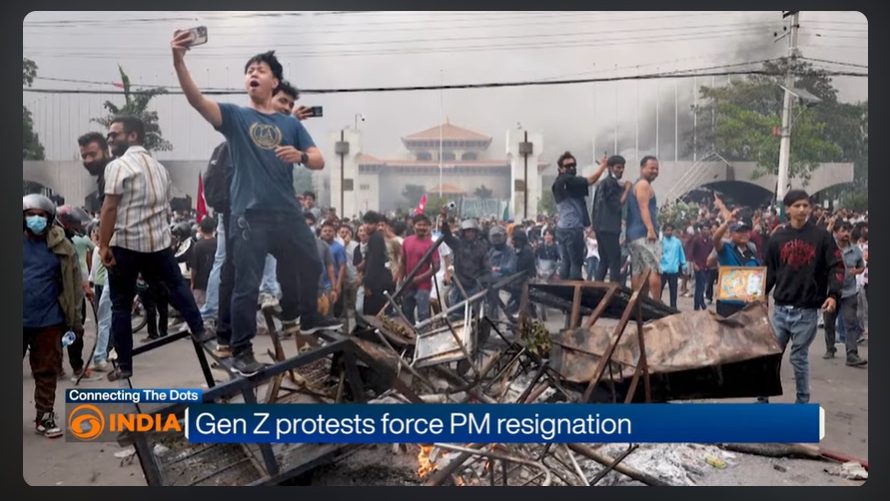
Young people fighting back and governments are forced to listen and act.
When my students ask how protesters coordinate without leaders, I used to point to social media. I was wrong.
Last summer, as Kenya's streets filled with tear gas and Nepal's government collapsed, I watched something I had studied for years play out with disturbing clarity. Sixty deaths in Nairobi. Seventy in Kathmandu. Twenty-two in Antananarivo. Each government made concessions. Each movement had no leaders to negotiate with.
‘Social media coordination’ became the refrain in news coverage. But as someone who has analyzed digital movements since Hong Kong's 2019 protests, I can tell you this explanation is maddeningly vague. It is like saying buildings stand up because of ‘construction’ without explaining what load-bearing walls do.
What I saw instead was something more specific and more unsettling: young people leaving traces in digital space that function like scent trails for ants. One person modifies the environment. Others encounter that modification and respond. No one directs the process. No one needs to.
Consider how it actually worked. In Nepal, an Instagram influencer named Saugat Thapa posted a photo of his Christmas tree. Not a pine tree -- a tower of luxury shopping bags. Cartier. Gucci. Louis Vuitton. Arranged like ornaments.
And by doing so, he altered Nepal's digital landscape by introducing an image that created cognitive whiplash. Christmas -- humility, giving, the Christ child in a manger. Luxury brands -- excess, inequality, conspicuous consumption. The contradiction demanded response.
Within hours, thousands created their own versions. Screenshots with biting captions. Satirical memes. Compilation videos. Each modification changed the environment further, creating pressure for more responses. A cascade with no architect.
This is not how we typically think coordination works. We imagine someone must be planning, directing, deciding. But watch ants building a nest. No ant holds the blueprint. Each responds to chemical traces left by others. Complex structures emerge from simple rules: if you encounter this stimulus, do that action.
The same pattern appeared across other countries. Indonesian protesters waved flags from the manga One Piece -- the Jolly Roger of a fictional pirate who liberates oppressed people. The symbol required no translation. Filipino protesters saw it online, recognized it, reproduced it. The flag's appearance in Jakarta modified Manila's environment by demonstrating tactical possibility.
Thai activists deposited strategies in hashtags like #MilkTeaAlliance. Kenyan protesters encountered those tactics, adapted them to Nairobi's streets, left their own modifications for others. Discord channels accumulated knowledge continuously. Nepal's ‘Youths Against Corruption’ server -- 7,586 members -- functioned as a shared environment where each contribution altered the coordinating space for whoever came next.
The most radical moment: Nepali activists used Discord to vote for an interim leader candidate. Collective decision-making through individual responses to a modified environment. Democracy emerging from aggregated stimulus-response cycles.
If this sounds powerful, it is. These movements forced concessions from multiple governments without the vulnerabilities that come with hierarchical leadership. No one to arrest. No one to co-opt. No one to corrupt.
But here is where my students' next question usually comes: If this works so well, why did Nepal's 2006 revolution -- which successfully overthrew the monarchy -- result in 17 successive governments and economic stagnation? Why did protestors, as one activist put it, end up ‘becoming part of the system and losing their moral ground’?
The answer reveals a fundamental tension in how these movements operate.
The same features that enable rapid mobilization prevent institution-building. Platforms amplify content that maximizes engagement -- watch time, shares, emotional reactions. TikTok promoted videos of ‘nepo kids’ flaunting wealth not because they possessed superior strategic value but because they generated outrage. Viral algorithms filter modifications based on commercial logic, not political logic. Coordination becomes oriented toward maintaining emotional engagement rather than building governance capacity.
Think about what gets shared versus what gets ignored. A photo of luxury goods shaped like a Christmas tree: viral. A 40-page policy proposal for constitutional reform: invisible. The architecture that enables coordination actively selects against the content needed for governing.
States understand this vulnerability. Nepal banned 26 platforms in September. Indonesia suspended TikTok's live feature. These interventions attempt to eliminate the substrate on which coordination operates. Sometimes they backfire -- Nepal's ban triggered an 8,000 percent spike in VPN signups and intensified grievances. But they reveal a deeper problem: movements dependent on corporate platforms are inherently fragile.
More troubling is the demographic boundary. These coordination mechanisms work best among people who share interpretive frameworks. Urban, educated, digitally literate youth recognize luxury brands, understand manga references, have platform access. Rural and older populations often encounter unmodified environments -- the traces fail to register as stimuli demanding response. Thailand's 2020 movement fragmented partly because content coordinating Bangkok students alienated these demographics.
The coordination boundary creates a paradox: movements appear massive because they mobilize millions online, yet remain narrow because they synchronize only certain demographics. This is not a coalition. It is an echo system mistaken for a society.
But the deepest limitation is temporal. These mechanisms excel at disruption. They struggle with construction. The Discord vote selecting an interim leader candidate demonstrated coordination but immediately raised the question: Who granted this group legitimacy? Aggregating preferences through modified environments is not the same as establishing governance authority.
This matters because toppling governments is the easy part. Every successful uprising faces the same challenge the morning after: building institutions that can actually govern: accountability structures, leadership emergence, organizational capacity. The translation of protest into policy.
These require different coordination mechanisms than viral outrage. They require sustained negotiation, which demands stable relationships. They require expertise, which demands credible authorities. They require compromise, which demands trust built over time. None of this emerges naturally from stimulus-response cascades optimized for rapid mobilization.
Enjoying this article?
Subscribe to get more stories like this delivered to your inbox.
I am not arguing these movements should adopt traditional hierarchies. The vulnerabilities of centralized leadership are real -- co-optation, corruption, state targeting. But I am arguing that movements cannot rely solely on digital coordination mechanisms if they want to govern, not just protest.
What would a hybrid approach look like? Combining online environmental modifications with physical organizing spaces where relationships form. Building accountability mechanisms not dependent on platform architectures designed for engagement maximization. Ensuring coordination reaches beyond specific demographics by creating multiple types of stimuli for multiple types of communities.
Most critically: movements must recognize that forcing regime concessions is no longer the hard part. These coordination mechanisms enable that. The challenge is building institutions that can govern afterward while retaining the autonomy, reproducibility, and scalability that made initial mobilization possible.
This is not a technical problem. It is a political one. Can movements evolve coordination mechanisms adequate for both disruption and construction? Can they leverage the power of environmental modification while developing the institutional depth that ephemeral traces cannot provide?
The answer will define not just whether the next uprising succeeds in forcing concessions, but whether it succeeds in building something durable afterward. Because the emerging pattern is: without institutions, today's revolutionaries can become tomorrow's problem. And the cycle can indefinitely continue.
For those watching these movements with hope or fear, the question is not whether young people can coordinate without leaders. They demonstrably can. The question is whether coordination without leaders can produce governance with legitimacy. That remains unanswered.
Marvin Starominski-Uehara is an Adjunct Assistant Professor at Temple University Japan and conducts research on human stigmegy. He holds a PhD in Political Science and International Studies from the University of Queensland, Australia.
Adjunct Assistant Professor, International Business & Environmental Studies, Temple University Japan