
China's push for tech independence: What it means for the rest of the world

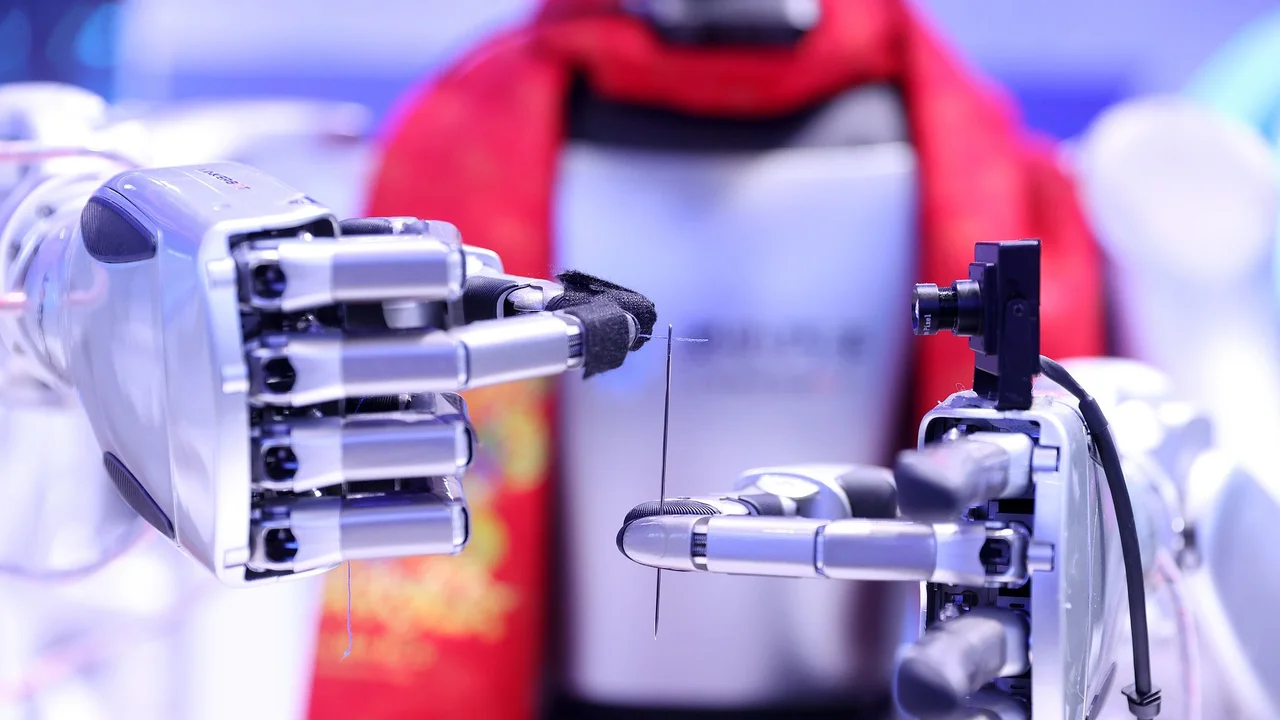
A robot threads a needle at the Zhongguancun Exhibition Center.
From AI-powered robots to homegrown chips and space exploration, China is investing heavily in technology. President Xi Jinping has made the drive for self-reliance a national priority. But can China turn its recent advances into lasting success — and what does that mean for the rest of the world?
On February 9, 2026, a pair of robotic hands in Beijing performed a remarkable feat. One held a needle while the other guided a thread, no thicker than a human hair, through the needle's eye.
Chinese President Xi Jinping watched the demonstration. The robot relied on nearly 20 motors working together, along with sensors that helped it make precise movements.
For Xi, the display was more than a technological showcase. It reflected one of his central goals for China: to develop the technologies it needs rather than depend on foreign suppliers.
That goal has taken on greater importance as global competition in technology has intensified and international restrictions on access to some advanced technologies have tightened.
In recent years, China has made progress in fields ranging from artificial intelligence to space exploration. The question is how China managed to innovate in its own way amid technological restrictions — and whether its drive for independence will also leave room for international cooperation.
From catching up to making its own breakthroughs
Xi has been calling for China to strengthen its technological capabilities for years. In 2018, he urged scientists and engineers to make breakthroughs in key technologies. He has since repeatedly stressed the need to improve basic research and reduce China's reliance on foreign technology by fully leveraging China's institutional advantage in mobilising resources nationwide.
The strategy is visible in China's semiconductor industry.
Chips are essential to almost every modern electronic device, from smartphones to advanced AI systems. China has invested heavily in developing its own chip industry, seeking to reduce its dependence on overseas suppliers.
In September 2026, Chinese memory-chip maker ChangXin Memory Technologies announced that a new generation of its DRAM technology had entered mass production. The development marked another step in China's effort to build up its domestic chipmaking capabilities.
AI and robotics offer another glimpse of China's ambitions.
Chinese companies are developing robots that can do far more than walk or perform choreographed routines. They are working on machines that can handle objects, navigate unfamiliar spaces and carry out tasks in factories and other workplaces.
Why manufacturing matters
Xi's technology strategy is closely linked to another priority: strengthening China's manufacturing industry.
China already has a vast network of factories, suppliers and skilled workers. That gives its companies an advantage when they want to test new products, improve designs and increase production.
A telling example comes from XCMG, one of China's major construction machinery manufacturers.
In 2017, Xi visited the company's factory in Jiangsu and asked about the technology used in its all-terrain cranes. At the time, the complete machine had a reported domestic component rate of 71%.
Five years later, a company representative told Xi that the rate had reached 100%, with all key components made in China. The company also reported major improvements in the cranes' performance.
The story illustrates what technological self-reliance can mean in practice. It is not simply about inventing a new product. It is also about developing the parts, skills and production methods needed to make it.
Xi has repeatedly argued that China must move beyond being a large manufacturing country and become a stronger player in advanced industries.
That is an ambitious goal. Having a large industrial base does not automatically make a country a leader in every technology. Long-term success also requires strong scientific research, skilled engineers and products that can compete in international markets.
A technology drive that reaches into space
China's ambitions extend well beyond its factories.
Under Xi's leadership, the country has continued to expand its space program. Its Tiangong space station, completed in 2022, allows Chinese astronauts to live and work in orbit and conduct scientific experiments over extended periods.
China has also made progress in lunar exploration. In 2024, its Chang'e-6 mission returned the first samples ever collected from the far side of the Moon — a major scientific achievement.
These projects serve national goals, but they also create opportunities for international research. China has invited foreign partners to take part in aspects of its space program, while researchers in different countries continue to explore ways to share scientific knowledge.
So far, China has signed nearly 200 space cooperation agreements with more than 50 countries and international organisations, covering areas such as Earth observation, lunar and deep-space exploration, and satellite development. 17 countries and international organisations have joined the International Lunar Research Station project.
At the 2023 International Astronautical Congress, China extended an open invitation to the world, welcoming all countries and regions committed to the peaceful use of outer space to partner with China and take part in missions aboard its space station.
That cooperation is now taking shape.
The selection of the first group of foreign astronauts has been completed. Two Pakistani candidates have begun training and one of them is expected to take part in a flight mission with Chinese peers in the foreseeable future.
The program stands as an example of how China's pursuit of technological self-reliance can coexist with deeper international cooperation.
Enjoying this article?
Subscribe to get more stories like this delivered to your inbox.
Many scientific challenges are global. Climate change, public health and the safe development of artificial intelligence cannot be solved by one country alone.
Countries may compete to develop the best technologies while still benefiting from sharing research, comparing results and working together on common problems.
What comes next?
Xi has made scientific and technological self-reliance a central part of China's modernisation plans. The reasoning is straightforward: a country that can develop more of its own critical technologies is less vulnerable to supply disruptions and outside restrictions.
But independence is not the same as tech hegemony. China has a civilisation stretching back 5,000 years. Historically, its four great inventions made major contributions to the progress of human civilisation.
When meeting foreign representatives attending the New Economy Forum in 2019, Xi said: "We have put forward the Chinese Dream of national rejuvenation, and this dream is by no means a hegemonic dream. We have no intention of supplanting anyone. We only hope to restore China’s due dignity and status."
China has set the goal of achieving high-level sci-tech self-reliance and strength and becoming a leading country in science and technology by 2035.
At the same time, China has emphasised that scientific and technological progress should remain open to international cooperation, help address global challenges, and bring greater benefits to people around the world.
For a closer look at the people, policies and achievements behind China's technology drive, listen to the podcast episode “At the Helm of Chinese Modernisation: The Path to Sci-Tech Self-Reliance” on "Stories of Xi Jinping".
Drawing on Xi Jinping's speeches and examples from robotics, manufacturing and space exploration, the program examines why China is pursuing technological independence, how that effort is changing its industries and what it could mean for the rest of the world.
Author: Yang Guang is a reporter with CGTN. He is also one of the editors of Stories of Xi Jinping.