
Deanston Cemetery: A forgotten chapter of Scotland’s tea legacy in Bangladesh

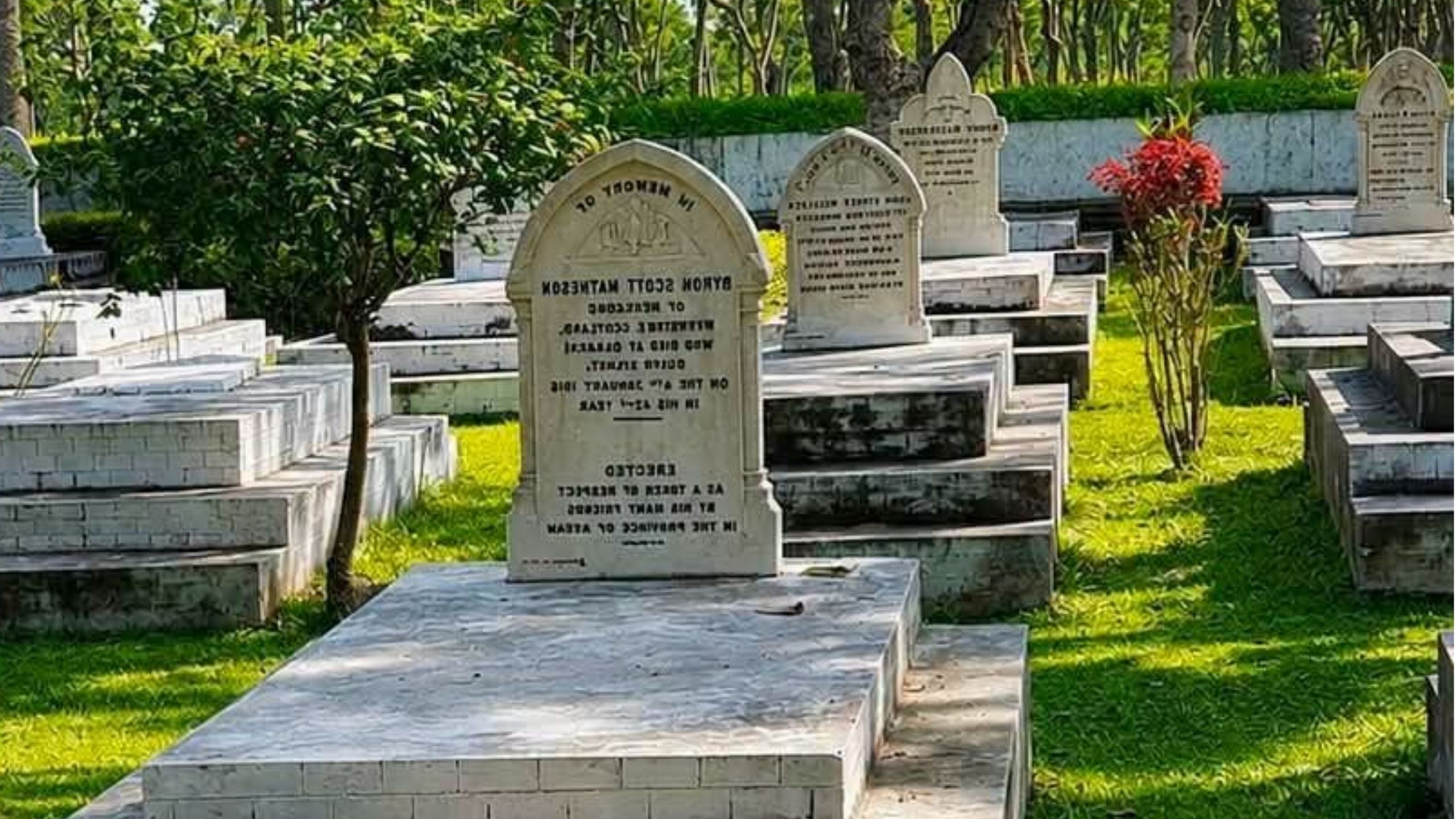
Deanston Cemetery in Sreemangal is more than a quiet colonial-era graveyard. Its white stone markers preserve the stories of Scottish tea planters and their families who lived, worked and died in the tea country of Sylhet. Surrounded by lush gardens, it remains a small but evocative piece of Scotland in Bangladesh.
In the northeastern corner of Bangladesh, in Sylhet Division’s Moulvibazar District, lies Sreemangal Upazila, famed across Bangladesh and beyond as the country’s tea capital and a major tourist destination. Situated in the east of the country, Sreemangal is surrounded by haors, hills, hillocks, lakes, wetlands, forests and protected areas, while tea gardens stretch across much of the landscape. Together, they give the upazila an almost picture-book beauty.
The area has been an important tea-growing region since the British period. Its transport network developed alongside the tea industry, including the railway that connected Sreemangal with other parts of the country. Today, more than 50 tea gardens are spread across the upazila, creating an extraordinary landscape of rolling green hills and neatly planted tea bushes.
Around Sreemangal, this tea-growing region is widely known as the Balisera Valley. Historically, it formed part of the broader Surma Valley, along with the Laskarpur, Longla, Manu-Dhalai and North Sylhet valleys. The Balisera landscape is defined by winding roads that rise and fall between tea gardens. Some stretches are flat; others roll gently across the hills.
Even the names of the gardens seem to have a rhythm of their own: Sindurkhan, Rajghat, Kakiachhara, Fulchhara, Kejurichhara and Bhurbhuria.
Unlike the familiar rural landscape of riverbanks, paddy fields, mustard fields and vegetable plots, this is overwhelmingly a land of tea. Here and there, small settlements of tea workers appear among the gardens. Traditional houses with earthen walls, old corrugated-tin or thatched roofs, and hand-painted alpana designs on walls and courtyards remain part of the landscape. Scattered among them are Assam-type bungalows with tin roofs, surrounded by tea gardens and trees.
There are few buildings that interrupt the landscape.
And then, unexpectedly, a cemetery appears.
It is remarkably neat and well maintained, almost as though it has been lifted from another country and placed among Sreemangal’s tea gardens. At first glance, it is clear that this is not an ordinary local graveyard. It is a burial ground of British-era tea planters.
The cemetery stands beside a road passing through the tea gardens, surrounded by trees. Moss, weeds and overgrowth have been kept at bay. Unlike the Brahma cemetery at Kauraid in Sripur, where visitors may have to tread carefully because of snakes and reptiles, this place creates an entirely different impression. It is so clean and dignified that visitors may instinctively feel inclined to leave their shoes outside before entering.
People commonly know it as Deanston Cemetery.
But the signboard beside the layout plan gives its formal name in English: Kejuricherra Cemetery, Deanston Tea Estate.
According to the layout shown on the signboard, there are 43 numbered graves, although graves numbered 2 and 33 are empty. That leaves 41 graves.
It is nothing like the vast Mainamati War Cemetery in Cumilla, where 736 graves of Allied soldiers from the Second World War are arranged in immaculate rows. Deanston Cemetery is small and lies on level ground. Nor does it resemble the larger Christian cemetery in Wari, Cumilla, with its variety of large and small memorial structures.
Deanston has no grand mausoleums.
Its distinction lies elsewhere.
The grave markers are made of white stone and carry intricate carvings and decorative designs. Though modest in size, several are remarkable works of craftsmanship. Comparable examples are difficult to find, except for one or two gravestones in the compound of the Armenian Church.
The condition of the stones is another striking feature. Nearly 150 years have passed, yet the grave markers remain largely intact, with little visible damage.
More than decoration, however, the inscriptions offer a window into the lives of the people buried here.
Photographs of the surviving grave inscriptions provide details of 19 individuals. Their years of death range from 1880 to 1922, indicating that the cemetery contains the graves of some of the earliest European tea planters and their families who came to the region.
The inscriptions also tell a story of fragile lives.
Some died as infants or children. Others died between the ages of 30 and 50. One grave belongs to “Sonny”, the nine-and-a-half-month-old son of a sergeant major.
James Peter Russell, aged 24, died in an accident in 1888 in the nearby Sindurkhan tea garden. At that time, there were no cars here.
For some of these young men, there may never have been an opportunity to return home.
In death, they became no different from a young man from Cumilla or Noakhali who might have died far from home in a workplace accident.
The inscriptions reveal something about the social world surrounding the young planters. For women and children, they often mention parents, husbands or other close relatives. For many of the young men, the names that appear most prominently are those of their “brother planters” or “brother planters and friends”.
The wording of the epitaphs repeatedly includes phrases such as “Erected by his brother planters” and “brother planters and friends.”
One young woman, Emily Graham, died of malaria.
Three of the 19 people identified from the inscriptions were children. One was Christina Annie, who died at the age of nearly three.
Another striking feature is the apparent Scottish identity of those buried here.
Those whose places of birth are recorded on the surviving stones were born in Scotland. There appear to be no English or Irish names among them.
To local people, they were all simply “sahibs”. But distinctions existed within the European community as well. The Scottish presence in the Balisera Valley was particularly strong.
The graves include people who died in Rajghat, Kalighat, Kejurichhara, Kaichhara and Udnachhara, as well as Sreemangal, Daragaon and Sindurkhan.
Why were so many Scots drawn to this remote corner of the subcontinent?
The answer lies in the extraordinary history of the tea industry.
Tea cultivation began in the Surma Valley in the 1860s. At the time, a kind of tea mania swept through Assam and Sylhet. The term “Assam” referred to the British Indian province that included the area corresponding to present-day Sylhet Division in Bangladesh. Some compared the rush to invest in tea with the California Gold Rush.
The promise of easy wealth drew people from Britain into the tea business. Captains, office clerks and others were tempted to leave their familiar lives behind and try their fortunes in the plantations.
The reality was far harsher.
The Surma Valley was then a landscape of forests, mosquitoes, malaria and, according to historical accounts, tiger territory.
For unemployed young men in Britain, however, Assam was portrayed as a “heavenly place”.
The romantic image of adventure in Assam was so strong that contemporary poets even wrote humorous verses about young Britons eager to travel there.
The early investors soon discovered that tea cultivation was not an easy road to wealth. In the early 1860s, some bought abandoned hillocks for Tk 100 and sold them for Tk 300, while others acquired land at considerably lower prices. Many eventually abandoned their ventures.
When the tea business began to recover several years later, James Finlay & Company entered the field. By around 1870, the company had acquired many of the tea gardens established by earlier European investors.
James Finlay was one of Scotland’s greatest overseas firms.
The company’s expansion was closely associated with John Muir. At one stage, the business became known as Finlay Muir & Company, although the name James Finlay remained widely used.
The company’s rise was built in significant part on its investments in the tea estates of the Surma Valley.
John Muir not only acquired financially troubled tea gardens but also secured large areas of undeveloped land in the Balisera Valley. He obtained 13,609 acres from the Maharaja of Tripura and purchased hillocks held by private owners throughout the region.
Finlay subsequently became the largest tea-estate owner in the Surma Valley.
By around 1885, the area under Finlay-owned tea gardens in the Balisera Valley alone accounted for more than half of the total tea-growing area of Sylhet.
By 1900, Sylhet had the highest tea production among all the districts of Assam.
The owners of the tea gardens enjoyed a status comparable to that of the traditional aristocratic zamindars of Sylhet.
By 1950, Finlay’s local workforce had reached 70,000. Alongside them was a large cadre of superintendents, managers and assistants sent from Scotland and elsewhere in the United Kingdom.
The Scottish connection to the tea gardens was therefore not incidental. It was built into the structure of the industry.
That connection is preserved today in the gravestones of Deanston.
The cemetery itself takes its name from Deanston, a small village in Scotland.
It is an intriguing coincidence that John Muir, the man who played a major role in turning James Finlay into a commercial giant, is buried in Deanston, Scotland.
The history of the people associated with these estates also survives in scattered records.
When Adam Hare, who had worked in the tea industry in this region, died at the age of 100, the Scottish newspaper The Herald published a full-page article about him on 22 November 2016.
The newspaper headline described him as a “tea planter who managed estates”, placing his tea-planting career above his military title of Lieutenant Commander in the Royal Indian Naval Reserve.
Enjoying this article?
Subscribe to get more stories like this delivered to your inbox.
A photograph published in The Herald that day is also connected with Deanston Cemetery. The article noted that Hare supervised the renovation of the church at Kalighat in Sylhet, in the Balisera Valley; carried out a major survey of the graveyard; and compiled a comprehensive record of everyone buried there.
The Scottish connection was not limited to Finlay. Several other tea-estate companies operating in the region were Scottish, making it unsurprising that many of the European planters who came to work in the surrounding gardens were Scots.
James Finlay left Bangladesh in 2006, selling its assets to Consolidated Tea and Land Company (BD) Limited.
But the company and the people who worked for it left behind a much older legacy.
On the gravestones of Deanston Cemetery, the names of Scottish towns and villages remain carved in stone. The cemetery itself carries the name of a small Scottish village thousands of miles away.
From time to time, descendants of those buried here still travel from different parts of the world to visit the graves of their ancestors.
For the tea workers of the region, however, the history of the tea gardens carries another, far more painful story.
Workers were brought to the plantations from different parts of the Indian subcontinent with promises and inducements. The phrase “Gach hilayega to paisa mileyega”—“shake the tree and you will earn money”—was used to attract labourers.
Their history is one of hardship and suffering spanning generations.
Yet the establishment and expansion of tea cultivation in the Surma Valley also amounted to an economic transformation for the region at the time. Ironically, much of that transformation came through the investment and enterprise of Scottish businessmen.
That complicated history is still visible in Sreemangal today.
The tea gardens, workers’ settlements, colonial-era bungalows, railway lines and cemeteries together form a landscape in which the past remains unusually tangible.
Deanston Cemetery is perhaps one of its most evocative reminders.
It is small. There are no monumental structures. There are only a few dozen graves, surrounded by greenery and tea gardens.
But each stone carries a fragment of a much larger story: of Scotland and Sylhet, of empire and enterprise, of tea and labour, of wealth and disease, of adventure and premature death.
The cemetery also reminds visitors that the history of Sreemangal did not begin with tourism.
Long before the town became known as the tea capital of Bangladesh and a cosmopolitan tourist destination, this landscape was being transformed by the tea industry.
Today, Sreemangal is surrounded by haors, hills, lakes, wetlands, forests, protected areas and tea gardens. Its natural beauty has made it one of Bangladesh’s best-known tourist destinations. Its railway and road connections, developed alongside the tea industry, have helped link the town with the rest of the country.
More than 50 tea gardens remain part of the upazila’s landscape.
But amid all that living greenery stands a quiet cemetery bearing the name of a small Scottish village.
Visitors come to Sreemangal to see the tea gardens, hills, forests and lakes. Some may stop at Deanston Cemetery without knowing the extraordinary history hidden behind its white stone markers.
Those stones tell another story of Sreemangal—one in which a distant country, Scotland, became unexpectedly intertwined with the economic and social history of this corner of northeastern Bangladesh.
Deanston Cemetery is therefore more than an old graveyard.
It is a small piece of Scotland in Sreemangal—and a silent archive of the people, ambitions, hardships and historical forces that helped shape the tea country of Bangladesh.
.