
The homeland cannot keep them, the dreamland does not want them
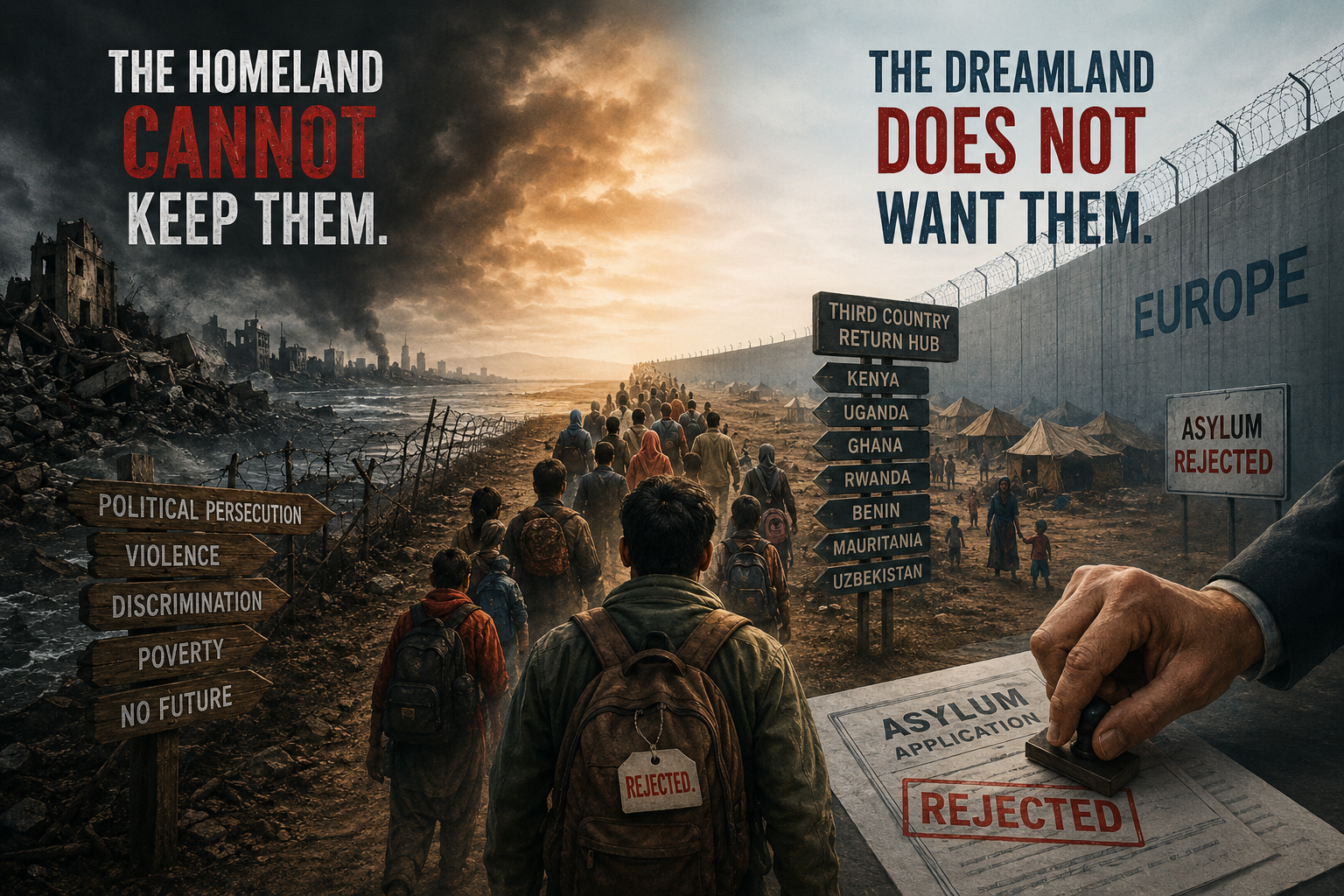
AI-generated editorial illustration symbolising the uncertain future of asylum seekers affected by Europe's proposed third-country return hub policy. The image is illustrative and does not depict any specific individual or actual event.
On July 27 2026, Bangladesh’s national daily Bonik Barta published a report headlined: “Five European countries want to send Bangladeshi asylum seekers to Africa.”
According to the report, Germany, Austria, Denmark, the Netherlands, and Greece are exploring the establishment of “return hubs” outside the European Union. Kenya, Uganda, Ghana, Rwanda, Benin, Mauritania, and Uzbekistan have reportedly emerged as possible locations.
Under the proposed arrangement, asylum seekers whose applications have been finally rejected, but who cannot immediately be returned to their countries of origin, could be temporarily transferred to one of these third countries.
At first, the idea seemed almost absurdly simple: Those who wanted to go to Europe would not reach Europe, but they would still have gone abroad.
Then came the second thought: it is not that simple at all.
Bangladeshi noted journalist Manjurul Ahsan Bulbul captured the contradiction in a verified Facebook post: “If they could live well in their own country, they would not want to become second- or third-class citizens in another country. Each person has a different story behind them.”
That sentence goes to the heart of the moral complexity surrounding Europe’s proposed “return hubs”.
There is, for now, no final agreement. The proposal remains part of a wider legal and political process within the European Union. But it nevertheless signals a potentially significant shift in Europe’s approach to asylum and migration.
The central question is this: if a person applies for asylum in Europe, is rejected, and is then sent to a third country with which they have no connection, can that be treated as merely an administrative decision?
Probably not.
An asylum seeker is not simply a passport, an application number, or a deportation file. Behind every application is a life. That life may contain political persecution, personal threats, insecurity, discrimination, economic collapse or the accumulated experience of believing that there is no future at home.
It is also true that some people travel irregularly to Europe in pursuit of a better life and use asylum as an alternative route to migration. Some claims may be false or exaggerated. That reality cannot be ignored.
But rejection is not the same as lying.
A claim may fail because the evidence is insufficient, because it does not meet the legal threshold for protection, or because the applicant’s circumstances do not fall within the relevant legal framework. None of these automatically makes the applicant a fraud.
The issue is particularly important for Bangladesh.
According to the European Union Agency for Asylum, 36,901 asylum applications were lodged by Bangladeshi nationals in the EU in 2025, making Bangladesh the fourth-largest country of origin among asylum applicants. First-instance decisions were issued on 43,523 applications involving Bangladeshi citizens, with a recognition rate of just 3 per cent.
These figures tell two stories.
The first is that a very large number of Bangladeshis are seeking asylum in Europe, while most applications fail.
The second is that 3 per cent were nevertheless found to qualify for protection.
The distinction matters. A 97 per cent rejection rate does not mean that every rejected applicant was a liar.
Bangladesh’s recent political and social turmoil makes the debate more complicated. Reports by domestic and international media and human rights organisations have documented political killings, violence, attacks on homes and businesses, assaults on journalists and attacks affecting minority communities.
At the same time, European policymakers have increasingly tended to regard Bangladesh as a safe country.
These positions are not necessarily contradictory.
A country may be broadly considered safe while some of its citizens face serious personal danger. Equally, political violence in a country does not mean that every citizen automatically qualifies for asylum.
A fair asylum system must therefore consider both the general conditions in a country and the individual circumstances of the person making the claim.
The phrase “Bangladesh is a safe country” cannot become a blanket reason for rejecting every application. But neither can every instance of political instability automatically become grounds for granting asylum.
Justice lies in the difficult space between those two positions.
European governments argue that many people who receive deportation orders ultimately cannot be returned to their countries of origin. As a result, they remain in Europe, increasing pressure on asylum systems.
The administrative logic behind a “return hub” is understandable.
But administrative efficiency can never replace human rights.
Before asylum seekers are transferred to a third country, basic questions must be answered. Is that country genuinely safe? Will fundamental rights be protected? Will independent legal assistance be available? Will there be effective judicial remedies? Will people be detained, and for how long?
International refugee law also rests on the principle of non-refoulement: a person must not be returned to a country where their life, freedom or security could face serious danger.
Establishing a facility outside Europe does not make Europe’s legal and moral responsibilities disappear.
Australia’s experience with offshore processing offers a warning. The prolonged uncertainty, psychological distress, limited legal assistance and long-term detention associated with third-country processing have generated years of controversy.
Europe must ensure that “return hubs” do not become a system for simply moving rejected asylum seekers out of sight and out of mind.
Enjoying this article?
Subscribe to get more stories like this delivered to your inbox.
There is also a question we too often avoid:
Why does a person leave their family, language, society and homeland to travel towards an unknown future?
Why do they pay smugglers vast sums of money? Why risk their lives crossing the Mediterranean? Why accept the precarious existence of a second- or third-class citizen in a wealthy country?
Some leave for higher incomes. Some seek a better life. Some exploit irregular migration routes.
But every person has a different story behind them.
Not every story amounts to a legal claim for asylum. But no just decision can be reached without listening to it.
This may be the deepest tragedy of all:
The homeland cannot keep them.
The dreamland does not want them.
At home, they cannot find security, dignity or a future. Abroad, they encounter rejection, uncertainty and an increasingly fractured sense of identity. Europe does not want to accept them. Africa’s proposed “return hubs” are not a dream destination. And for many, returning home does not feel safe, attractive or even possible.
What kind of life is that?
To spend years searching for somewhere to belong.
Europe has a responsibility to prevent abuse of asylum systems without denying protection to those who genuinely need it. If people are transferred to third countries, those countries must be genuinely safe, humane and legally accountable.
Bangladesh also has a responsibility.
Discouraging irregular migration is not enough. The country must ask why people leave through dangerous routes, why some fear returning, and why they abandon their birthplace rather than build a future at home.
Without answering those questions, return hubs, deportations and border controls will never address the roots of the problem.
Because no matter how far people are sent, if the reasons that drove them to leave remain unchanged, they will continue searching for another address.
And then the question will not belong only to Europe.
Nor to Africa.
It will belong to us:
Why can the homeland no longer hold on to its own children?
Contributing writer at The Independent News