
From church bells to live-in arrangements: How the Filipino family formation is quietly shifting

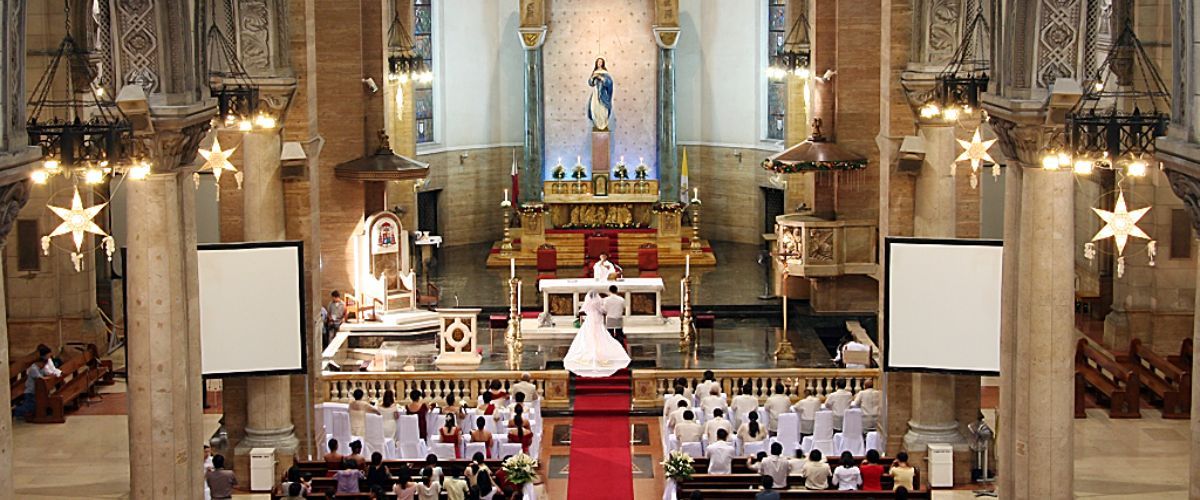
A Filipino wedding held at the Manila Cathedral in the Philippines
PHILIPPINES: Formal marriage in the Philippines is becoming less common, with registered marriages falling 13.5% over the past decade, from 429,723 in 2014 to 371,825 in 2024. This comes even as marriage remains deeply valued in Filipino culture. And increasingly, the data points to economics as a central driver.
According to the Philippine News Agency (PNA), the Philippines’ Commission on Population and Development (CPD) highlighted the trend in a statement on Tuesday, with Undersecretary Lisa Grace Bersales framing it as a reflection of changing economic realities and shifting social aspirations rather than a weakening of family values.
“The data clearly show that the Filipino family is evolving. This reflects changing economic realities, shifting aspirations, and emerging pathways to family formation,” she stated.
A decline interrupted by the pandemic, and then resumed
The downward trend was briefly reversed after the COVID-19 pandemic, when marriages that had been postponed during lockdowns were finally solemnised. Registrations rebounded sharply to 449,428 in 2022, after falling to a low of 240,775 in 2020.
However, the trend then resumed with force: Marriages fell by 7.8% to 414,213 in 2023, and by another 10.2% to 371,825 in 2024, suggesting the pandemic rebound was a one-time correction rather than a reversal of the longer-term pattern.
Filipinos are also marrying later
The data also show that Filipinos are entering marriage at older ages than they were a decade ago. The median age at marriage in 2024 was 30 for males and 28 for females, which are two years older than the corresponding figures of 28 and 26 recorded in 2015.
Couples aged 25 to 29 continued to account for the largest share of newlyweds. The CPD attributed the rising age at marriage to changing educational, employment and economic circumstances.
February remained the most popular month for weddings, accounting for 12.4% of annual marriages, while November recorded the fewest. Geographically, CALABARZON led all regions with 54,981 marriages in 2024, followed by NCR with 48,448 and Central Luzon with 42,227. All of these together accounted for nearly 40% of all registered marriages nationwide.
Civil weddings also continued to outnumber church weddings, with 41.8% of marriages solemnised through civil ceremonies, compared to 31.7% through Roman Catholic ceremonies.
Cohabitation is surging in its place
The decline in formal marriages is running in parallel with a significant rise in cohabitation. The 2020 Census recorded 12.66 million Filipinos in common-law relationships. The 2025 National Demographic and Health Survey found that 20.5% of women aged 15 to 49 were living with a partner. This was an increase from 18.8% in 2022 and a dramatic rise from just 5% in 1993. The figure has effectively quadrupled over three decades.
According to PNA, the CPD said cohabitation has become a practical arrangement shaped by economic realities, changing social norms, and individual aspirations, with many couples viewing formal marriage as simply too expensive. Research cited by the agency also indicated that cohabitation is often seen as a more accessible option for couples managing unintended pregnancies and rising living costs.
The shift is also visible in birth statistics. In 2023, there were 842,728 births outside marriage, which was significantly more than the 605,794 births among formally married couples.
The policy challenge
Bersales said government policies need to evolve alongside these changes, ensuring that families in informal unions receive adequate protection and access to essential services, while also removing financial barriers for those who do wish to marry.
“Government has a responsibility to create an environment where Filipinos who aspire to marry and raise families are not constrained by financial hardship or unnecessary barriers. At the same time, we must ensure that women, children, and families in informal unions receive appropriate protection and access to essential services,” she was quoted as saying by PNA.
Enjoying this article?
Subscribe to get more stories like this delivered to your inbox.
Child marriage remains a concern
While adolescent marriages have declined over the past decade, the CPD said every case of child marriage remains a concern given its long-term consequences for education, health, and future opportunities. In 2024, 3.2% of registered marriages involved an adolescent male or female, with female adolescents often married to older partners with age gaps ranging from one to nine years to more than 20 years.
Bersales cited Republic Act No. 11596, which prohibits child marriage, as an affirmation of the government’s commitment to protecting Filipino children from early unions that deprive them of opportunities to complete their education and make informed choices about their future.
A family that is evolving, not disappearing
Taken together, the data present a picture not of marriage in crisis, but of family formation in transition, which is shaped by economic pressures, longer education pathways, rising costs of living, and a generational shift in how Filipinos view formal union.
The challenge for policymakers is ensuring that those transitions are supported by systems that protect all families, regardless of their structure.